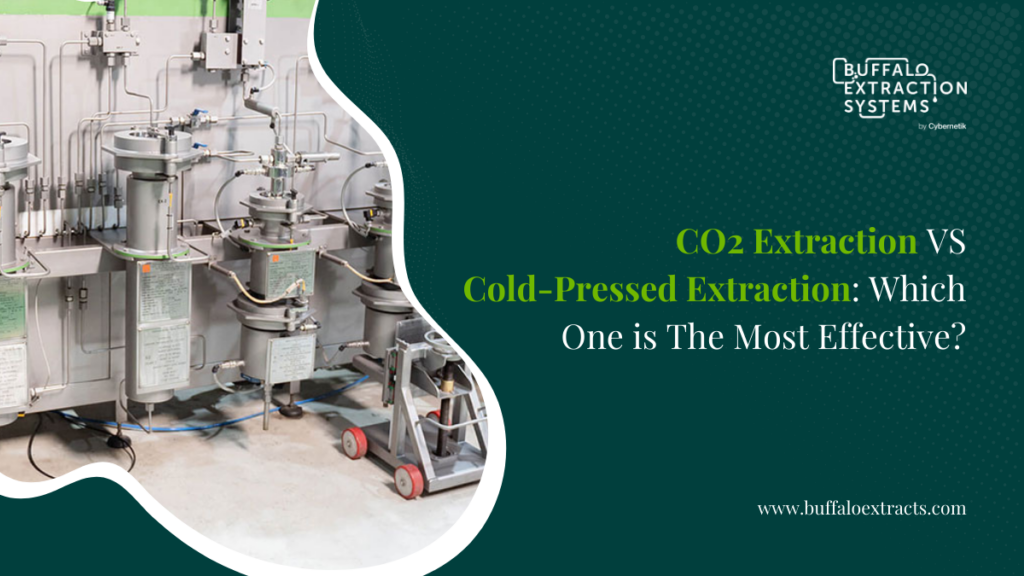
When evaluating cold pressed vs co2 extraction for your business, the decision comes down to what you need to produce. Cold press extraction is a simple mechanical process - you press oil-rich seeds or fruit peel and oil flows out. CO2 extraction uses pressurised carbon dioxide to dissolve specific compounds from almost any botanical material. The cold pressed method of extraction has no solvents at all, but it also has no selectivity. CO2 extraction gives you precise control over exactly what you extract.
Cold Pressed vs CO2 Extraction: Direct Comparison
|
Factor |
Cold Press Extraction |
CO2 Extraction |
|
Process |
Mechanical pressure squeezes oil from seeds or peel |
High-pressure CO2 dissolves then releases target compounds |
|
Raw materials |
Oil-rich seeds, nuts, and citrus peel only |
Almost any botanical: spices, cannabis, hops, florals |
|
Compound selectivity |
Non-selective - all oil extracted together |
High - tuneable by adjusting pressure (100–600 bar) |
|
Non-volatile bioactives |
Some, mixed into the oil |
Yes - gingerols, piperine, curcuminoids fully captured |
|
Solvent residue |
None |
None - CO2 reverts to gas completely |
|
Yield from raw material |
40–70% of available oil |
85–98% of target extractables |
|
Operating temperature |
Ambient |
35–60°C - gentle |
|
GMP pharmaceutical suitability |
Not standard |
Full GMP, ASME, CE certification available |
|
Organic certification |
Compatible |
Compatible - EU 2018/848, USDA NOP |
|
Scalability |
Limited - batch mechanical |
Lab to full industrial scale |
|
Clean-label claim |
'Cold-pressed, unrefined' |
'Solvent-free, CO2 extracted' |
What Is the Cold Pressed Method of Extraction?
The cold pressed method of extraction applies mechanical force - through a hydraulic or screw press - to plant material containing natural oil. The pressure ruptures oil cells and the oil flows out. No heat is applied beyond what friction generates mechanically. This produces authentic, 'whole food' oils that retain their natural character: hemp seed oil, flaxseed oil, olive oil, and citrus peel oils are classic cold-pressed products.
The limitation of cold press extraction is fundamental: it only works where there is physically enough oil in the raw material to squeeze out. You cannot cold-press dried ginger, cannabis flowers, hops, or most spice materials and get any commercially useful output. The technique is excellent for what it does, but it covers a very narrow range of raw materials.
When you compare CO2 vs cold-pressed comparison for botanicals like ginger or turmeric, the difference goes beyond yield. mechanical cold pressing produces only the lipid fraction - and most of the commercially valuable bioactives in spices (piperine, gingerols, curcuminoids) are non-volatile, non-lipid compounds that cold pressing cannot access at all. CO2 at the right pressure captures the full bioactive profile.
Businesses already using the cold-pressing extraction method and considering a move to CO2 should start with a Level 1 pilot system to develop their CO2 recipes and validate market response. For the full guide to CO2 extraction methods and types, see what are the different types of supercritical CO2 extraction processes. For why CO2 is classified as a green solvent, see reasons why supercritical fluids are called green solvents. For cannabis-specific extraction method comparison, see cannabis oil extraction methods.
FAQs
Q: What is the main difference between CO2 vs cold-pressed comparison?
A: mechanical cold pressing uses mechanical pressure to squeeze oil from oil-rich seeds and peel - no chemistry involved. CO2 extraction uses pressurised CO2 as a tunable solvent to pull specific compounds from almost any botanical material. For CO2 vs cold-pressed comparison, the key practical difference is raw material range (cold pressing works only for oil-rich materials) and compound access (CO2 captures non-volatile bioactives that cold pressing entirely misses).
Q: Is cold-pressed oil better than CO2 extracted oil?
A: They serve different purposes. Cold-pressed seed oils (hemp seed, flaxseed, olive) are excellent for food and nutrition where the whole lipid profile is the product. CO2 extracts are superior when specific bioactive compounds are the target - cannabinoids, curcuminoids, piperine, gingerols. Neither is universally 'better' - they suit different products.
Q: What raw materials can mechanical cold pressing work with?
A: mechanical cold pressing works with oil-rich seeds (hemp seed, flaxseed, sunflower, pumpkin), citrus peel (lemon, lime, orange, bergamot), and olives. It cannot be applied to most spice, cannabis flower, hop, or pharmaceutical botanical extraction needs - those require CO2 or solvent-based methods.
Q: What yield does CO2 extraction achieve compared to cold pressing?
A: CO2 extraction recovers 85–98% of target extractables from most botanical raw materials. Cold pressing recovers 40–70% of available oil from oil-rich seeds before mechanical force can extract no more. Beyond yield, CO2 accesses non-volatile compounds that cold pressing cannot reach at all, so the comparison is not just volume but compound completeness.
Q: Do both methods leave zero solvent in the final product?
A: Yes. mechanical cold pressing uses no solvents - it is purely mechanical. CO2 extraction also leaves zero solvent residue because CO2 returns to gas when pressure is released. Both produce inherently solvent-free products. This is one area where they are equivalent - the differences lie in raw material range, compound selectivity, and scalability.
Q: Can I use CO2 extraction for hemp seed oil?
A: The oil extracted from hemp seeds is best produced by cold pressing - it is a simple, cost-effective method for this specific application and 'cold-pressed hemp seed oil' is a recognised, valued product label. CO2 extraction of hemp flower produces CBD-rich cannabinoid extracts - a different product entirely, from a different part of the plant, for a different market.