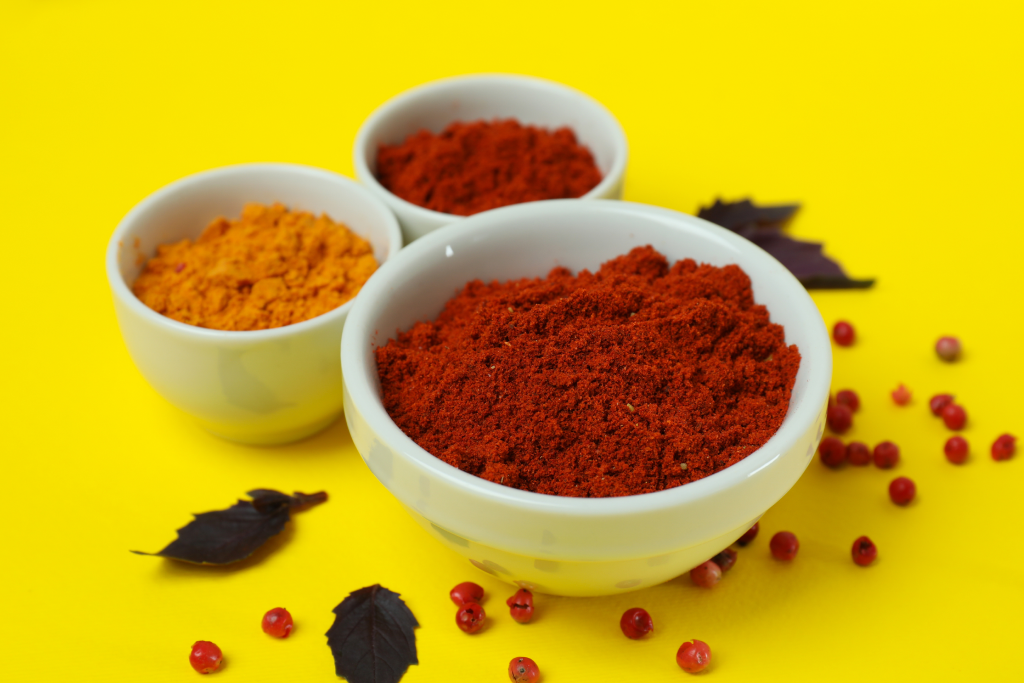
Annatto is the natural colour behind the orange-yellow shade in cheddar cheese, many snack coatings, and countless “no artificial colours” food labels - extracted from the waxy outer coating of seeds from the Bixa orellana tree, grown mainly in Peru, Brazil, Kenya, and India. What surprises a lot of formulators new to the ingredient is that “annatto” isn’t a single colour system at all; it’s a family of two chemically distinct pigments with different solubility, different applications, and - as of a 2021 EU regulatory change - different labelling requirements.
Find the Right Extraction System for Your Application
Bixin vs. Norbixin: Two Pigments, Two Applications
Annatto seeds contain roughly 4.5–5.5% pigment by weight, of which 70–80% is bixin.[1] The two forms diverge from there:
- Bixin is fat-soluble, produced by solvent extraction of the seed coating. It’s the form used in fat-based systems - cheese, butter, margarine, and oil-based snack coatings - where it delivers a warm orange shade.
- Norbixin is produced by hydrolysing extracted bixin in a hot alkaline solution, converting it into a water-dispersible form. It’s typically sold as a potassium or sodium salt and used in aqueous systems - beverages, dairy drinks, and water-based sauces - where bixin simply won’t disperse evenly.
A third, less common form - oil-steeped annatto, where seeds are steeped directly in food-grade vegetable oil - produces a lower-concentration extract suited to direct addition in fat systems without a separate solvent-extraction step.
The 2021 EU Labelling Change
For years, both pigment forms were grouped under a single designation: E160b. That changed under Commission Regulation (EU) 2020/771, effective for products manufactured after 2 January 2021, which split the additive into two separate codes because bixin and norbixin carry different toxicological profiles and different acceptable daily intakes.[3] Since that change:
Designation | Pigment | Form |
E160b(i) | Annatto bixin | Fat-soluble |
E160b(ii) | Annatto norbixin | Water-soluble |
The European Food Safety Authority’s assessment set an ADI of 6 mg bixin per kg body weight per day, and a considerably lower 0.3 mg per kg body weight per day for norbixin - a tenfold difference that reflects genuinely different safety margins between the two forms, not just a regulatory technicality.[4] Manufacturers exporting into the EU need labels that reflect the correct subcode for whichever form is actually used in the formulation, and products still showing the old blanket “E160b” designation on new production runs risk falling out of compliance.
Choosing the Right Form for Your Application
Getting this choice wrong shows up immediately in the finished product - either as a colour that won’t disperse or as an unwanted oily film. A quick guide:
- Cheese, butter, margarine → bixin (fat-soluble)
- Snack seasoning oils, fried coatings → bixin or oil-steeped annatto
- Beverages, dairy drinks, water-based sauces → norbixin (water-soluble)
- Confectionery with both fat and water phases → often requires a blend or careful sequencing of both forms
Manufacturers building a broader food colour program alongside annatto often pair it with other carotenoid-based colours like chili oleoresin for a wider orange-to-red shade range, since annatto alone tends to sit more toward yellow-orange than deep red.
Extraction Method and Purity
Solvent extraction (typically using hexane, ethanol, or acetone under controlled conditions) produces the highest-purity pigment fractions and is the standard commercial route for both bixin and norbixin production. Seed quality, harvest timing, and post-harvest drying conditions all directly affect final pigment yield and stability, which is why manufacturers sourcing annatto extract should ask suppliers for seed origin and harvest documentation, not just a generic colour-strength specification. A supplier working from certified, traceable seed sources - increasingly common given rising demand for supply-chain transparency in clean-label flavours and colourants alike - typically delivers more consistent pigment concentration lot to lot.
Beyond Straight Colour Applications
Annatto extract also appears in fortified foods formulations, where its carotenoid content contributes both colour and a modest antioxidant profile, and manufacturers running broader processing machinery operations often integrate annatto dosing directly into existing colour-addition lines rather than treating it as a specialty ingredient requiring separate handling.
Why Buffalo Extraction Systems Fits In
Pigment extraction is unforgiving of processing inconsistency - a shift in temperature or pressure between batches can visibly change a bixin extract’s colour strength, which is a problem no colour formulator wants to discover after a production run is finished. Buffalo Extraction Systems’ CO2 platforms are built with the precise pressure and temperature control this kind of pigment work demands, along with GMP-aligned hygienic design that supports the documentation food colour manufacturers need for both EU and US regulatory submissions. For processors evaluating a shift from solvent-based annatto processing toward a cleaner extraction route, that combination of consistency and compliance-ready design is the starting point worth understanding.
Frequently Asked Questions
Is annatto colour considered a natural or artificial food additive? Natural. Annatto is extracted directly from Bixa orellana seeds without chemical synthesis, which is why it’s a popular choice for “no artificial colours” label claims.
Why did the EU split E160b into two separate codes? Because bixin and norbixin have different toxicological profiles and acceptable daily intakes. Regulation (EU) 2020/771 required the split so labelling accurately reflects which pigment form - and which safety threshold - applies.
Can bixin and norbixin be used in the same product? Yes, and it’s common in products with both fat and water phases, such as certain confectionery, where each form colours its respective phase rather than one form trying to cover both.
Does annatto colour affect the taste of a food product? At typical colouring inclusion levels, no - annatto is essentially flavourless in the concentrations used for colour. Any detectable flavour usually signals an overdose or a lower-purity extract.
The Takeaway
Annatto’s split into bixin and norbixin isn’t just chemistry trivia - it directly determines which food matrix a formulation will work in, and since 2021 it determines which E-number subcode belongs on the label. Manufacturers who get the pigment form, extraction documentation, and current labelling requirements right avoid both a formulation failure and a compliance headache.