Calibration Is the Quality Foundation That Makes Every Process Record Meaningful
Equipment calibration GMP extraction is a foundational requirement of every regulatory framework governing pharmaceutical, nutraceutical, and botanical extract manufacturing. FDA 21 CFR Part 211.68 requires that instruments used to measure, control, or record manufacturing processes be calibrated at defined intervals against traceable standards. EU GMP EudraLex Volume 4 Chapter 3 and ISO/IEC 17025 laboratory calibration requirements extend the same obligation to all instruments affecting product quality decisions.
Find the Right Extraction System for Your Application
In extraction manufacturing, calibration affects product quality directly: a temperature controller reading 2°C low during CO2 extraction changes the density and selectivity profile of supercritical CO2, potentially co-extracting unwanted compounds or reducing target compound yield. A pressure gauge reading out of tolerance means process parameters are not being controlled at the values specified in the validated process. Extraction equipment calibration GMP compliance is not about having calibration stickers on instruments - it is about knowing that the instruments measuring and controlling your process are giving accurate readings throughout each batch.
Why Calibration Is a GMP Requirement, Not Just Best Practice
GMP calibration extraction facility requirements exist because instrument accuracy is the link between process parameters and product quality. In a regulated extraction facility, process parameters - temperature, pressure, flow rate, mass, time - are set, monitored, and recorded on the assumption that the instruments measuring them are accurate. If that assumption is false, the process records are inaccurate, the batch record is inaccurate, and any investigation relying on process data is compromised.
FDA 21 CFR Part 211.68 specifies that instruments shall be calibrated at suitable intervals, using standards traceable to national or international standards where existing. A GMP calibration extraction facility that cannot demonstrate instrument traceability to NIST (US) or PTB/NPL (EU) reference standards will face observations on calibration programme adequacy during inspection. EU GMP expectations under EudraLex Volume 4 Annex 15 extend calibration requirements into the validation context: any instrument used in qualification or validation studies must have a current calibration certificate traceable to national standards.
What Must Be Calibrated in a GMP Extraction Facility
Extraction instrument calibration covers every instrument that measures or controls a parameter affecting product quality, or that generates GMP records used in batch decisions. In a supercritical CO2 extraction facility, the calibration program extraction GMP must cover at minimum:
- Temperature sensors and controllers: process vessel temperature, separator temperature, heat exchanger inlet and outlet, and ambient sensors for environmental monitoring. Extraction temperature calibration GMP requires calibration against traceable reference thermometers at defined intervals - typically annually for process instruments, more frequently for critical measurement applications.
- Pressure instruments: pressure gauges and transducers on the extraction vessel, separators, CO2 feed line, and pump outlet. Pressure gauge calibration extraction GMP is particularly critical for supercritical CO2 systems operating at 100–350 bar: a gauge reading out of tolerance at these pressures represents a significant process control risk. Calibration interval for process-critical pressure instruments is typically quarterly to semi-annually.
- Flow meters: CO2 flow rate, co-solvent delivery rate, and (for cryo-ethanol systems) ethanol flow rate. Calibration confirms that solvent-to-feed ratios are controlled at validated values.
- Balances and scales: used for weighing botanical feedstock, co-solvent additions, and extract yields. Calibration program extraction GMP for balances includes daily check weight verification plus full calibration against traceable weights at defined intervals.
- Analytical instruments in the quality control laboratory: HPLC, GC, UV/Vis, and other instruments generating in-process and release test results. Calibration records extraction facility for analytical instruments must demonstrate traceability to pharmacopoeial reference standards.
The extraction GMP calibration schedule documents every instrument subject to calibration: the calibration interval, the reference standard used, the acceptance criteria, and the calibration status (current certificate date and next due date). The schedule is the primary document an auditor reviews to assess whether the calibration program extraction GMP is adequately designed.

Building a Calibration SOP and Schedule for Extraction
The extraction calibration SOP GMP is the procedural backbone of the calibration programme. It must define:
- Scope: which instruments are subject to calibration, identified by instrument category and equipment ID number
- Calibration intervals: how frequently each instrument is calibrated, based on instrument type, criticality, use frequency, and manufacturer recommendations
- Reference standards: which traceable reference standards are used for each instrument type, and how the traceability chain is documented in calibration records
- Acceptance criteria: the tolerance within which an instrument is considered calibrated - for example, ±0.5°C for process temperature sensors; ±1% full-scale for pressure gauges
- Out-of-tolerance procedure: what happens when an instrument is found out of tolerance - quarantine from GMP use, retrospective impact assessment on batches manufactured since the previous passing calibration, CAPA initiation, repair before return to service
- Documentation: the calibration record format, the minimum information that must be captured for each calibration event, and the record retention requirement
The critical GMP calibration extraction audit question on calibration SOPs is: does the SOP define acceptance criteria for every calibrated instrument category, and is there a documented out-of-tolerance procedure that includes a retrospective impact assessment on batches manufactured since the previous passing calibration? CAPA in GMP extraction: how to fix problems properly covers the CAPA process triggered by an out-of-tolerance calibration finding.
Calibration Records: What Regulators Look For
Calibration records extraction facility must demonstrate, for every calibration event: the instrument identity (equipment ID, serial number, location), the calibration date, the name of the person who performed the calibration, the reference standard used (with certificate number and traceability), the as-found reading before calibration, the adjustment made if any, the as-left reading after calibration, and whether the calibration passed or failed the defined acceptance criterion.
GMP calibration extraction audit inspection consistently reviews calibration records for three patterns:
- No as-found data: indicating calibration records were completed after the fact, not during the calibration event - a data integrity concern
- Instruments found significantly out of tolerance with no documented impact assessment on recent batches manufactured while the instrument was potentially inaccurate
- Calibration certificates from reference laboratories not accredited to ISO/IEC 17025, with no reference standard traceability documented
The calibration records extraction facility must be retained for the life of the equipment plus the GMP record retention period - typically not less than 7 years for EU GMP compliance and the batch release period plus 1 year for FDA-regulated facilities.
Where Buffalo Extraction Systems Fits In
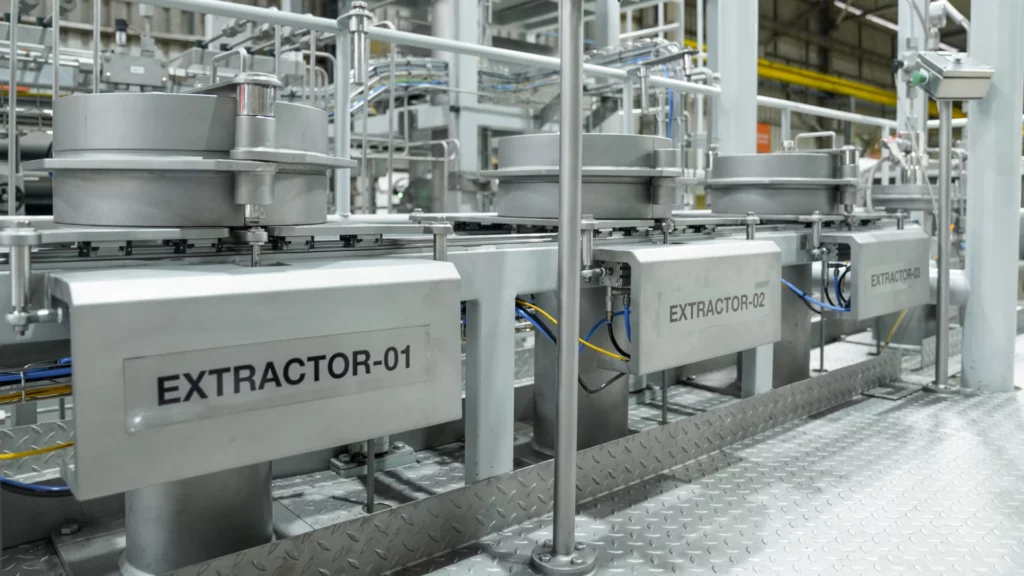
Buffalo Extraction Systems extraction equipment is CE, ASME, and PED certified; cryo-ethanol systems also ATEX certified; supplied with GMP documentation (USFDA, Health Canada, EU-GMP as required). This spans CO2 SCFE at 5L×2, 25L×2, and 100L×2 configurations and cryo-ethanol systems at 5 kg, 20 kg, and 50 kg per batch. Each system runs SCADA that records instrument readings continuously throughout every batch, producing a time-stamped process record tied to the calibration state of the temperature sensors, pressure transducers, and flow meters feeding it. For a GMP calibration extraction facility, that relationship is foundational: the SCADA batch record is only as reliable as the instruments behind it, which is why calibration programme integrity is a prerequisite for meaningful process documentation rather than a parallel administrative requirement.
Conclusion
Equipment calibration GMP extraction is the quality foundation that makes process records meaningful. Every extraction temperature calibration GMP record, every pressure gauge calibration extraction GMP certificate, and every balance calibration verification is part of the evidence chain that connects instrument readings to product quality decisions. A GMP calibration extraction facility that cannot produce a traceable calibration certificate for every instrument that contributed to a batch decision is operating without the evidentiary foundation that GMP requires. The extraction calibration SOP GMP defines the programme; the calibration records extraction facility are the proof it was executed.
Related Articles
- GMP Compliance for Botanical Extracts via CO2 Extraction
- How BES Ensures GMP Compliance for Your Extraction Process
- Enhancing Extract Purity: 100% Food-Grade Standards in Large-Scale CO2 Extraction
Frequently Asked Questions
What is equipment calibration in GMP extraction?
Equipment calibration GMP extraction is the systematic process of comparing instruments used in extraction manufacturing against traceable reference standards, verifying that they read within defined acceptance criteria, and documenting the result. Required by FDA 21 CFR Part 211.68, EU GMP EudraLex Volume 4, and ISO/IEC 17025, a GMP calibration extraction facility must calibrate all instruments that measure or control parameters affecting product quality - including temperature sensors, pressure gauges, flow meters, and balances. The calibration records extraction facility serve as the evidentiary foundation for every process record those instruments generated.
Which instruments require calibration in a supercritical CO2 extraction facility?
Extraction instrument calibration in a CO2 facility covers: temperature sensors and controllers (process vessel, separator, heat exchanger), pressure gauges and transducers (vessel, separator, pump outlet), CO2 and co-solvent flow meters, and analytical balances. Calibration program extraction GMP also covers laboratory analytical instruments used for in-process and release testing. The extraction GMP calibration schedule documents every instrument, its calibration interval, the reference standard, and the acceptance criterion - and is the primary document a GMP calibration extraction audit inspector reviews.
What is required in a GMP extraction calibration SOP?
The GMP extraction calibration SOP must define: the scope of instruments subject to calibration; calibration intervals by instrument type and criticality; traceable reference standards and the traceability chain documentation; acceptance criteria for each instrument category; the out-of-tolerance procedure including retrospective batch impact assessment and CAPA initiation; and the calibration record format and retention requirement. A GMP calibration extraction audit inspection focuses on whether acceptance criteria and out-of-tolerance procedures are defined for every calibrated instrument category - not just whether calibration certificates exist.
How frequently should pressure gauges and temperature sensors be calibrated in extraction?
Extraction GMP calibration schedule frequency is based on instrument criticality, use frequency, and historical stability. Pressure gauge calibration extraction GMP for process-critical gauges on CO2 systems operating at 100–350 bar is typically quarterly to semi-annually. Extraction temperature calibration GMP for process temperature sensors is typically annual for stable instruments, with a shorter interval for instruments with a history of calibration drift. The calibration SOP should define intervals for each instrument category based on a documented risk assessment - not simply adopt the manufacturer's recommended interval without evaluation.
What happens when an instrument is found out of tolerance in a GMP extraction facility?
When extraction instrument calibration identifies an out-of-tolerance reading, the instrument must be quarantined from GMP use until repaired and recalibrated. A retrospective impact assessment is required for all batches manufactured since the previous passing calibration - this is a CAPA trigger. The impact assessment documents whether any batch decisions relied on the readings of the out-of-tolerance instrument, and what the quality risk to those batches is. Calibration records extraction facility document the out-of-tolerance finding, the corrective action, and the recalibration result. The GMP calibration extraction audit inspector will look specifically for whether this retrospective assessment was performed and documented.