SIL Certification Quantifies the Reliability of the Safety Functions That Protect Your Extraction System
SIL certification extraction requirements address a specific question: given that a safety function exists in your extraction system - a high-pressure shutdown, an emergency vent, a temperature high interlock - how reliably does it work when it is needed? Safety Integrity Level (SIL) is a quantified measure of that reliability, defined by IEC 61508 (functional safety of electrical, electronic, and programmable electronic safety-related systems) and applied to process industries through IEC 61511. For extraction systems operating at high pressures with flammable or cryogenic solvents, the safety functions protecting against catastrophic overpressure, ignition, or thermal excursion are not theoretical safeguards - they are the last line of defence between process upset and serious incident. SIL certification makes the reliability of those functions measurable, auditable, and improvable.
Discover the Right Extraction System for Your Needs
What SIL Means: Safety Integrity Levels and Probability of Failure
SIL is expressed on a four-level scale (SIL 1 through SIL 4) representing an order-of-magnitude improvement in reliability at each step. The key metric is Probability of Failure on Demand (PFD): the probability that a safety function will fail to operate correctly when called upon. SIL 1 requires a PFD between 0.1 and 0.01 (failure in 1 in 10 to 1 in 100 demands); SIL 2 between 0.01 and 0.001; SIL 3 between 0.001 and 0.0001. SIL 4, applicable only to the most safety-critical applications, requires PFD below 0.0001 and is rarely encountered in process industry extraction applications.
SIL certification extraction systems do not receive a single SIL rating - each Safety Instrumented Function (SIF) within the system is assessed individually. A SIF is a complete safety loop: sensor (pressure transmitter, temperature sensor) + logic solver (safety PLC, safety relay) + final element (shutdown valve, depressurisation valve). The reliability of the SIF as a whole is determined by the reliabilities of its three components combined, accounting for common-cause failures, diagnostic coverage, and proof test intervals.
SIL Safety Extraction Equipment: Which Functions Require Assessment
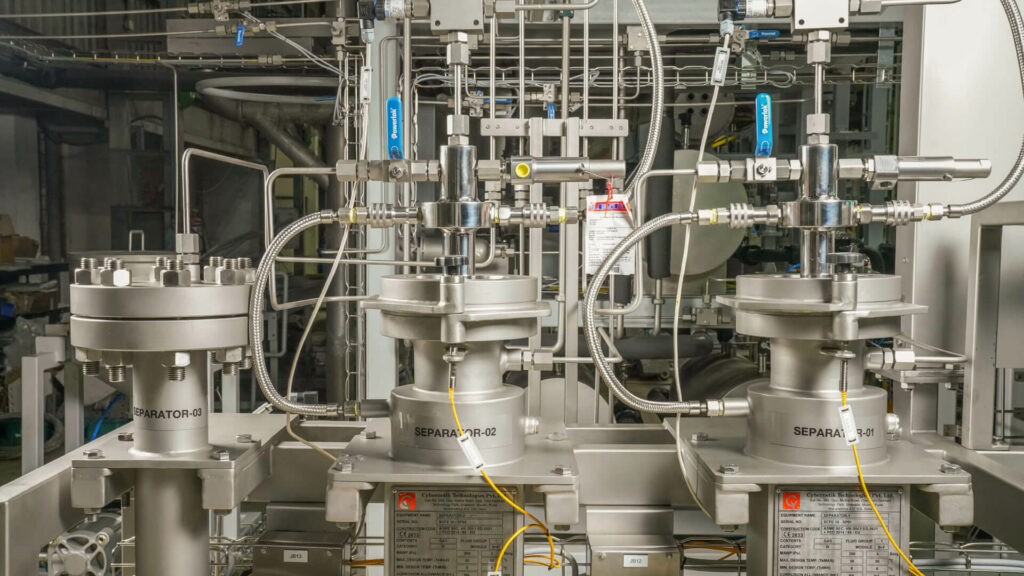
For extraction systems, the safety instrumented functions most commonly requiring SIL assessment are: high-pressure shutdown (HPSD) - the interlock that closes the feed valve and activates depressurisation when operating pressure exceeds a defined high limit; high-temperature shutdown - the interlock preventing thermal runaway in the extraction vessel or separator; emergency depressurisation systems - the automated or manual-initiated pathway for safely reducing vessel pressure in an emergency; and high-level shutdown for separators - preventing liquid carry-over into downstream equipment.
SIL-rated safety functions in extraction systems operate alongside the broader safety validation framework that governs pharmaceutical and nutraceutical extraction - where purity, potency, and contamination control are validated alongside the functional safety of the equipment protecting the process. For regulated extraction facilities, the safety instrumented system documentation and the product quality validation documentation are both required by auditors and regulators, covering equipment safety and product integrity as parallel disciplines.
The SIL Assessment Process: HAZOP, LOPA, and Verification
SIL certification extraction system assessment follows the safety lifecycle in IEC 61508 and IEC 61511. Hazard identification through a Hazard and Operability Study (HAZOP) is the first step - a multidisciplinary team reviews each node of the extraction process against deviation guide words to identify hazardous events and their consequences: runaway overpressure, vessel rupture, fire from solvent release, personnel exposure to cryogenic or hot fluid.
From the HAZOP findings, a Layer of Protection Analysis (LOPA) determines the required risk reduction. LOPA evaluates each hazardous event against the tolerable risk target (typically expressed as probability of fatality per year), accounts for risk reduction from non-SIS safeguards (process design, passive protection, operator response), and identifies the residual risk that the Safety Instrumented System must address. The required SIL for each SIF is the output of the LOPA.
The proof test interval - the frequency at which SIL-rated safety functions are tested to detect dangerous undetected failures - is a critical parameter in extraction system safety design. Quality control at scale for high-volume extraction facilities connects the broader QC discipline with the functional safety programme: both require systematic, documented, interval-based testing with results retained as evidence of ongoing fitness for purpose. A proof test is, in effect, a quality assurance activity for the safety function.
SIL Extraction Equipment Certification: Component vs System Level
SIL certified extraction machine components - pressure transmitters, safety-rated shut-off valves, safety PLCs - carry their SIL capability data from the component manufacturer, expressed as PFDAVG and safe failure fraction (SFF) for that device. This data is used by the SIS designer in the SIL verification calculation for the complete SIF. A component carrying a SIL 2 certificate does not automatically make the SIF SIL 2 - the overall SIF PFD depends on the combination of sensor, logic, and final element, and the proof test interval.
System-level SIL verification is performed by the SIS designer or a functional safety assessor. The output is a safety case document - the SIL verification report - demonstrating mathematically that the designed SIF achieves the PFD range required for the target SIL. This document forms part of the overall safety documentation for the extraction facility and is the evidence base for the SIL claim.
Where Buffalo Extraction Systems Fits In
Buffalo Extraction Systems extraction equipment is CE, ASME, and PED certified; cryo-ethanol systems also ATEX certified; supplied with GMP documentation (USFDA, Health Canada, EU-GMP as required). This spans CO2 SCFE at 5L×2, 25L×2, and 100L×2 configurations and cryo-ethanol systems at 5 kg, 20 kg, and 50 kg per batch. Each system runs SCADA that records instrument readings continuously throughout every batch, producing a time-stamped process record tied to the calibration state of the temperature sensors, pressure transducers, and flow meters feeding it. GMP compliance for botanical extracts produced via CO2 extraction covers the regulatory quality framework that governs extraction in pharmaceutical and food-grade applications, where instrument calibration integrity and SCADA batch record reliability are the documentation foundation that connects process performance to product quality.
Conclusion
SIL certification extraction assessment makes the reliability of safety functions measurable rather than assumed. Safety Integrity Level is assigned per Safety Instrumented Function - the high-pressure shutdown loop has a SIL requirement determined by the risk it controls, and SIL verification confirms that the designed loop achieves that reliability level. For high-pressure extraction systems handling flammable or cryogenic solvents, functional safety extraction SIL assessment is increasingly part of the regulatory and insurance landscape - particularly where automated safety functions replace or back up manual operator response.
Frequently Asked Questions
What is SIL and how does it apply to extraction systems?
Safety Integrity Level (SIL) is a quantified measure of the reliability of a safety function - how reliably it operates when called upon. Defined by IEC 61508 and applied to process industries through IEC 61511, SIL ranges from SIL 1 (lowest) to SIL 4 (highest). For extraction systems, SIL applies to Safety Instrumented Functions - complete safety loops consisting of a sensor, logic solver, and final element - that protect against hazardous events such as overpressure, thermal runaway, or loss of containment of flammable solvents.
What SIL level is typically required for extraction system high-pressure shutdown?
The SIL requirement for high-pressure shutdown (HPSD) in extraction systems is determined by Layer of Protection Analysis (LOPA) based on the specific hazard, consequence severity, and available non-SIS safeguards. There is no universal SIL level - it depends on the consequence of the overpressure event, the frequency of the initiating event, and the credit given to other safeguards. SIL 1 or SIL 2 are the most common outcomes for extraction system pressure protection SIFs in pharmaceutical and food-grade extraction applications.
What is the difference between SIL certification and ATEX certification?
ATEX certification (EU Directive 2014/34/EU) ensures equipment does not ignite a potentially explosive atmosphere - it addresses the equipment's explosion protection characteristics. SIL certification (IEC 61508/61511) quantifies the reliability of safety instrumented functions designed to prevent hazardous conditions from developing. ATEX ensures extraction equipment does not become an ignition source; SIL ensures the emergency shutdown system reliably stops the process if a hazardous condition develops. Both address different layers of the safety architecture.
Is SIL certification a legal requirement for extraction equipment in the EU?
SIL certification is not directly mandated by name in EU directives for extraction equipment. However, the Machinery Directive (2006/42/EC) requires that safety-related control systems achieve a performance level consistent with the risk assessment - and IEC 62061 and ISO 13849-1 provide the harmonised standard routes to demonstrating that performance level, which maps to SIL equivalents. For extraction facilities subject to Major Accident Hazard (COMAH/Seveso III) regulations, functional safety assessment with SIL determination is expected. Insurers and process safety auditors increasingly require SIL demonstration for critical safety functions.
What is a proof test and why does it matter for SIL-rated extraction safety systems?
A proof test is a periodic functional test of a Safety Instrumented Function that detects dangerous undetected failures - failures that prevent the SIF from operating correctly but do not generate a diagnostic alarm. For extraction system safety functions (pressure shutdown valves, emergency depressurisation systems), the proof test involves partially or fully stroking the shutdown valve, verifying the logic solver response to a simulated process high signal, and confirming sensor calibration. The proof test interval is a critical parameter in the SIL PFD calculation - a longer interval allows more dangerous undetected failures to accumulate, degrading the effective reliability of the SIF.