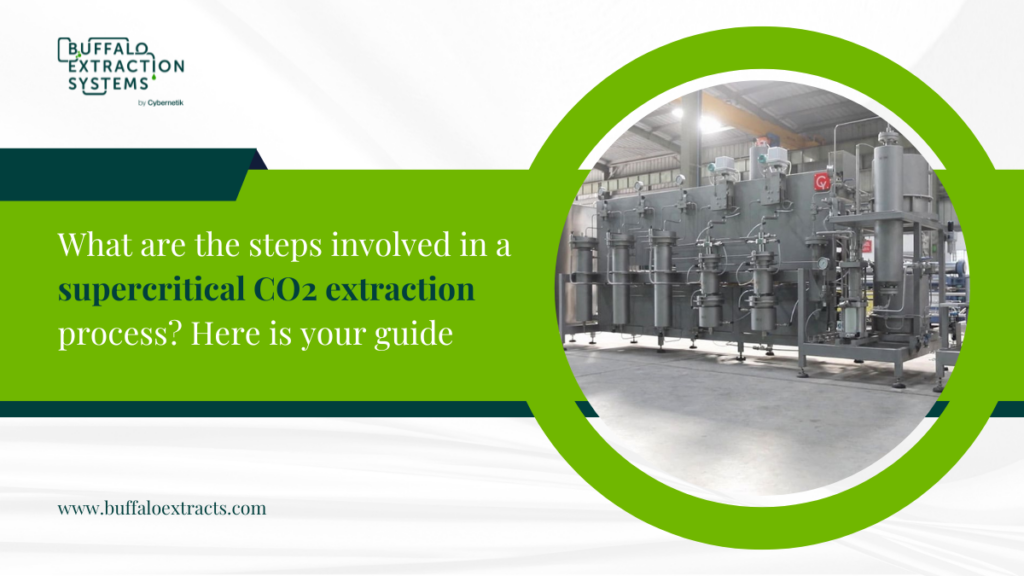
The CO2 extraction workflow steps turn ordinary CO2 gas into a powerful, clean solvent by applying pressure and gentle heat. When CO2 is pushed above 31.1°C and 73.8 bar simultaneously, it becomes a co2 supercritical fluid - a state where it has the density of a liquid and the speed of a gas at the same time. This makes the CO2 extraction workflow uniquely efficient: it dissolves specific compounds from plant material, and when pressure is released, the CO2 simply turns back into a gas and disappears, leaving zero residue.
How the CO2 extraction workflow steps work: 6 Steps
|
Step |
What Happens |
Why It Matters |
|
1. Prepare raw material |
Dry plant material below 12% moisture. Grind to 0.5–2 mm. |
Wet or unevenly ground material blocks CO2 penetration. |
|
2. Pressurise the CO2 |
A pump raises CO2 above 73.8 bar. A heat exchanger raises temp above 31.1°C. |
CO2 enters the supercritical phase - liquid-like solvating power. |
|
3. Extract |
The co2 supercritical fluid flows through the plant vessel at the set pressure. |
Pressure determines which compound class dissolves - set lower for terpenes, higher for oleoresins. |
|
4. Separate |
Loaded CO2 passes through separator vessels at lower pressure. Extract drops out. |
Reducing pressure removes CO2's solvating power - extract precipitates cleanly. |
|
5. Recover CO2 |
CO2 condenses and recirculates. Good systems recover over 95% per batch. |
Closed-loop recovery keeps operating costs very low. |
|
6. Collect extract |
Pure, solvent-free extract collected from the separator outlet. |
No stripping needed. The extract is ready to use immediately. |
Pressure Settings in the CO2 Extraction Workflow
The pressure you choose is the most important variable in the whole process. Lower pressure extracts light aromatic terpenes. Higher pressure extracts heavier oleoresins. Very high pressure reaches lipids and waxes. Most commercial operations set pressure between 150 and 400 bar, depending on their target compound.
|
Pressure Range |
What Gets Extracted |
Typical Product |
|
100–150 bar |
Light terpenes, delicate aromatics |
Cardamom essential oil, mint oil |
|
150–250 bar |
Medium aromatic compounds and light resins |
Cinnamon, black pepper, and terpenes |
|
250–400 bar |
Oleoresins - piperine, gingerols, curcuminoids |
Ginger oleoresin, turmeric extract |
|
400–600 bar |
Lipids, waxes, heavy compounds |
Pharmaceutical lipid fractions |
The CO2 extraction workflow steps are the only commercial extraction technology that achieves zero solvent residue while giving operators precise control over selectivity by adjusting pressure. Unlike hexane or ethanol extraction, which require energy-intensive downstream stripping, the CO2 extraction workflow is inherently clean - the solvent removes itself when pressure drops.
For a full comparison of all CO2 extraction types - standard, subcritical, modified, fractionated - see types of CO2 extraction workflow steps. For choosing equipment that fits your production scale, see scaling from lab to industry: choosing the right extraction equipment size. For consistent batch outcomes across raw material variations, see how manufacturers achieve consistent flavor profiles with advanced extraction.
FAQs
Q: What are the CO2 extraction workflow steps in simple terms?
A: It uses CO2 above 31.1°C and 73.8 bar - a CO2 supercritical fluid - as a solvent to pull specific compounds from plant material. The pressure set determines what dissolves. When you reduce pressure at the end of the CO2 extraction workflow, CO2 turns back into a gas and disappears, leaving a pure, residue-free extract.
Q: Why does pressure matter so much in this process?
A: Pressure controls selectivity. At low pressure (100–150 bar), only light volatile terpenes dissolve. At high pressure (250–400 bar), heavy oleoresins with piperine, gingerols, and curcuminoids dissolve. Adjusting pressure is how operators target exactly the compound class they want without changing the solvent.
Q: What exactly is a CO2 supercritical fluid?
A: A supercritical CO2 phase is CO2 held above its critical temperature (31.1°C) and critical pressure (73.8 bar) simultaneously. In this state, it has the dissolving density of a liquid and the rapid penetration of a gas - combining properties that make it an ideal, tunable extraction solvent.
Q: How is this different from solvent extraction?
A: In conventional solvent extraction, you add liquid hexane or ethanol and then heat the liquid away after extraction. With supercritical CO2, the solvent simply turns back to gas when pressure drops - no heating, no stripping, no residue. It is also non-flammable and non-toxic, unlike most conventional solvents.
Q: How much CO2 is recirculated per batch?
A: Industrial systems recover and recirculate over 90–95% of CO2 per batch. Make-up CO2 needed is typically less than 50 g per kg of processed biomass. This makes ongoing CO2 costs a very small fraction of total operating costs compared to conventional solvent systems.
Q: How long does each batch take?
A: Typical batch times are 2–6 hours, depending on vessel volume, pressure setting, flow rate, and desired extraction completeness. Optimised SCADA-controlled systems with recipe management run consistent cycles with minimal operator intervention.