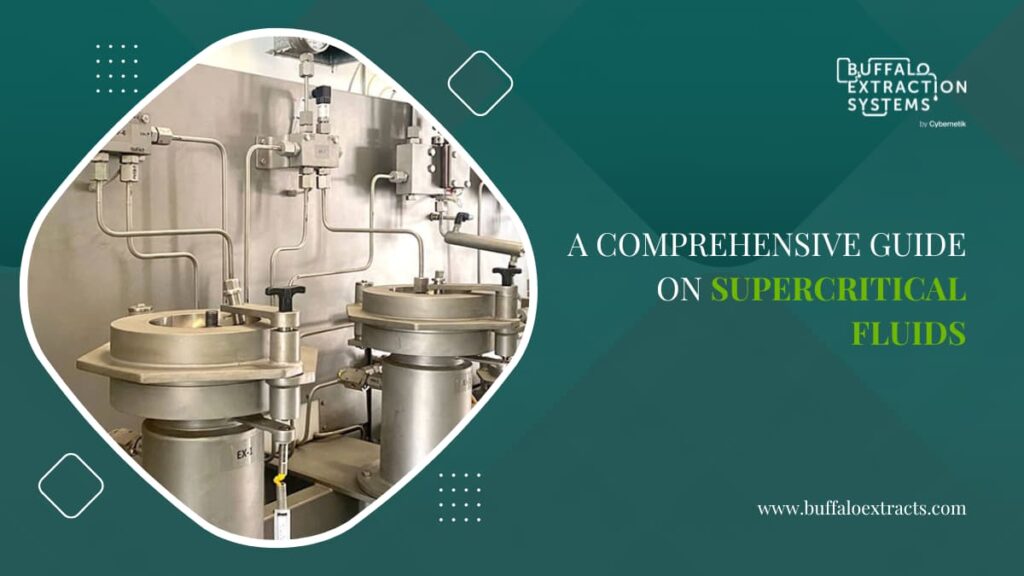
This guide will explain supercritical fluid extraction clearly, starting from first principles. If you have been told that SFE technology is important for your industry but are not yet sure exactly how it works, this is the right place to start. We will use a real supercritical fluid example - CO2 - to walk through the physics, explain why this technology matters commercially, and help you understand what questions to ask when evaluating it for your business.
How to Explain Supercritical Fluid Extraction: The Basics
Every substance can exist as a solid, liquid, or gas depending on temperature and pressure. But there is a fourth possibility. If you raise both the temperature and pressure of a substance above specific threshold values - called its 'critical point' - the substance enters a supercritical phase. In this phase, the distinction between liquid and gas disappears.
In the supercritical phase, the substance has liquid-like density (so it can dissolve compounds) and gas-like diffusivity (so it can penetrate solid materials quickly). This combination makes it an exceptionally powerful solvent. To explain supercritical fluid extraction simply: it is extraction using a substance in this special fourth state - dense enough to dissolve, mobile enough to penetrate, and able to be tuned in its solvating power by adjusting pressure.
The Best CO2 as a supercritical fluid: Carbon Dioxide
The best commercial CO2 as a supercritical fluid is CO2. Carbon dioxide enters the supercritical phase above 31.1°C and 73.8 bar of pressure simultaneously. This combination is modest and commercially achievable at industrial scale. Above these conditions, CO2 has the solvating density of a liquid and the penetrating speed of a gas - making it the ideal extraction solvent for botanical compounds.
|
Supercritical Fluid |
Critical Temperature |
Critical Pressure |
Primary Industrial Use |
|
CO2 (the dominant CO2 as a supercritical fluid) |
31.1°C |
73.8 bar |
Food, pharma, cannabis, cosmetics - the commercial standard |
|
Water |
374°C |
221 bar |
Hazardous waste treatment (SCWO) - extreme conditions |
|
Ethane |
32.2°C |
48.8 bar |
Lipid extraction - flammable, limited use |
|
Propane |
96.7°C |
42.5 bar |
Edible oil processing - flammable, limited use |
|
Nitrous Oxide |
36.4°C |
72.5 bar |
Some pharmaceutical extractions - similar polarity to CO2 |
To understand supercritical fluid extraction for CO2 specifically: CO2 above 31.1°C and 73.8 bar dissolves botanical compounds when flowing through plant material. When pressure is released, the CO2 reverts to a gas - completely disappearing from the extract. This makes it a zero-residue solvent: no stripping, no post-processing, no residual chemical in the final product.
SFE technology extends well beyond extraction. In pharmaceutical manufacturing, it is used for drug particle engineering (RESS, SAS processes that produce particles at precise sizes for controlled-release formulations). In textiles, supercritical fluid technology in CO2 dyeing eliminates water consumption. In environmental applications, supercritical water oxidation (SCWO) destroys hazardous organic waste at 374°C and 221 bar.
For the full range of industrial applications of supercritical fluids across sectors, see a guide to supercritical fluid and its applications across industries. For why CO2 is classified as a green solvent, see reasons why supercritical fluids are called green solvents. For pharmaceutical applications of SFE technology, see supercritical CO2 extraction in pharmaceuticals: driving innovation and purity standards.
FAQs
Q: How would you understand supercritical fluid extraction to a non-specialist?
A: Imagine a substance that can act like both a liquid and a gas simultaneously. Above certain temperature and pressure conditions, CO2 enters this 'supercritical' state - dense enough to dissolve compounds out of plant material, but also mobile enough to penetrate it quickly. When you release the pressure, the CO2 turns back into a gas and disappears completely, leaving behind a pure, residue-free extract. That is supercritical fluid extraction in practical terms.
Q: What is a CO2 as a supercritical fluid from everyday industrial life?
A: The most common everyday industrial CO2 as a supercritical fluid is CO2 being used to decaffeinate coffee - a process that has been running at commercial scale since the 1980s. The same principle is used for extracting spice oleoresins (ginger, black pepper, turmeric), producing CBD from cannabis, extracting botanical actives for cosmetics, and making pharmaceutical-grade botanical APIs. CO2 is the dominant supercritical fluid example across all of these industries.
Q: What is SFE technology used for beyond extraction?
A: SFE technology beyond extraction includes: pharmaceutical drug particle engineering (RESS and SAS processes producing particles at specific sizes for controlled-release formulations); supercritical CO2 textile dyeing (replacing thousands of litres of water per batch with a closed-loop CO2 process); and supercritical water oxidation (SCWO - supercritical fluid technology using water at 374°C and 221 bar to destroy persistent hazardous organic pollutants).
Q: Why is CO2 the most commonly used supercritical fluid commercially?
A: Four reasons: (1) its critical point (31.1°C, 73.8 bar) is commercially accessible at modest cost; (2) it is non-toxic, non-flammable, and GRAS-certified for food use; (3) it leaves zero residue - ICH Q3C exempt for pharmaceutical use; (4) it recirculates at over 95% efficiency per batch, keeping ongoing operating costs very low. No other substance combines all four of these properties at practical industrial conditions.
Q: What is the critical point and why does it matter for extraction?
A: The critical point is the specific temperature and pressure above which a substance enters the supercritical phase. For CO2: 31.1°C and 73.8 bar. Above this point, CO2 has liquid-like solvating density and gas-like diffusivity simultaneously - the ideal combination for selective extraction. Below this point, CO2 is either a gas (poor solvating power) or a liquid (good solvating power, but poor penetration). The critical point is the threshold that makes the technology useful.
Q: Can supercritical fluid extraction be used for cannabis?
A: Yes - CO2 is the preferred method for pharmaceutical-grade cannabis extraction. Above 31.1°C and 73.8 bar, CO2 extracts CBD, THC, CBG, and terpenes with zero solvent residue. Pressure setting controls which compounds are extracted: lower pressure (100–250 bar) preserves terpene profiles; higher pressure (200–350 bar) targets cannabinoid-rich fractions. CO2 is the only cannabis extraction technology that simultaneously meets pharmaceutical GMP standards globally.