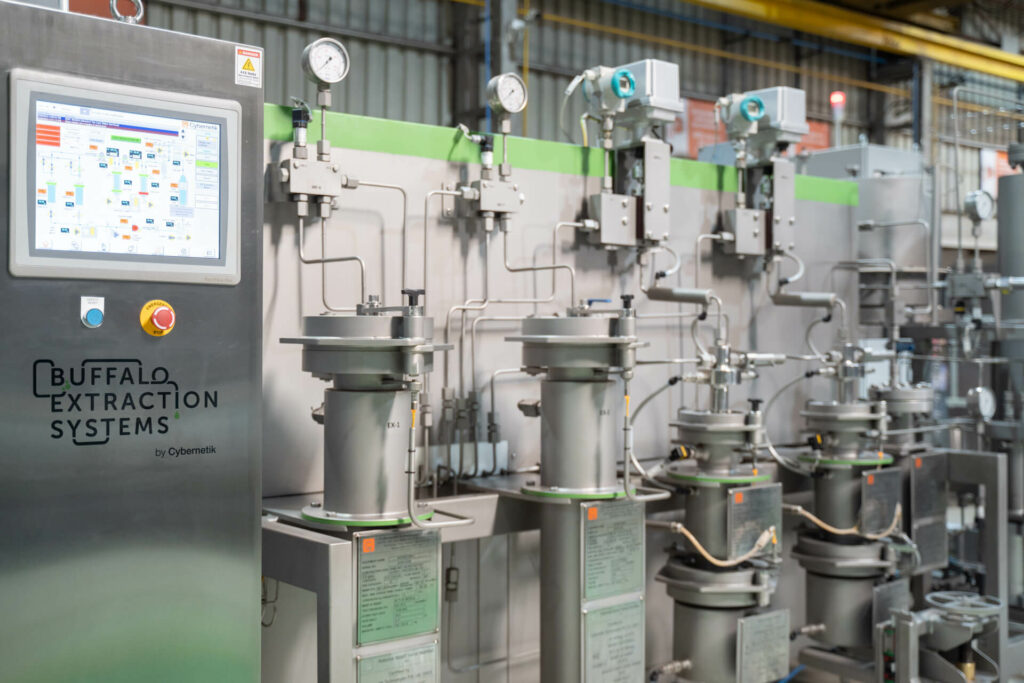
Supercritical CO2 pharmaceutical extraction is becoming the preferred method for producing botanical active pharmaceutical ingredients (APIs) at clinical and commercial scale. The reason is straightforward: it produces zero residual solvent - meaning no ICH Q3C limits apply - while operating at low temperatures (35–80°C) that preserve heat-sensitive compounds. Understanding the supercritical fluid extraction advantages and disadvantages helps pharmaceutical producers make the right investment decision.
Why Supercritical CO2 Pharmaceutical Extraction Outperforms Conventional Methods
Criterion | CO2 Extraction | Conventional Solvent Extraction |
Residual solvent | Zero - ICH Q3C not classified (no limit applies) | Class 1, 2, or 3 - testing and limits mandatory |
Temperature | 35–80°C - preserves thermolabile APIs | Often >60°C - thermal degradation risk |
Selectivity | High - tuneable by pressure adjustment | Low - broad-spectrum co-extraction of impurities |
GMP certification | Fully available: ASME, CE, GMP, ATEX | Standard - GMP available |
Organic certification | EU 2018/848, USDA NOP compatible | Not compatible (hexane); limited (ethanol) |
Solvent disposal | Near-zero - >95% CO2 recirculated | Significant - hazardous waste costs |
Supercritical fluid extraction advantages and disadvantages | Advantages: zero residue, tuneable, GMP-compatible. Disadvantage: higher CAPEX; CO2 is low polarity (co-solvent needed for polar compounds) | Conventional: lower CAPEX. Disadvantages: residue, thermal damage, hazardous waste |
What Pharmaceutical Products Use CO2 Extraction?
Supercritical CO2 pharmaceutical extraction is used to produce: cannabis-based medicines (CBD for epilepsy, THC for chemotherapy nausea), standardised ginger oleoresin (antiemetic API), piperine from black pepper (bioavailability enhancer in drug formulations), curcuminoid extracts (anti-inflammatory), omega-3 pharmaceutical concentrates (EPA/DHA), and lipid-based drug delivery excipients for liposomal formulations.
To summarise the supercritical fluid extraction advantages and disadvantages for pharmaceutical planning: the advantages are decisive for most botanical API applications - zero ICH Q3C classification, pharmaceutical-grade purity, GMP/ASME/CE certifiable, organic-compatible, and near-zero solvent disposal costs. The main limitations are higher equipment capital cost versus conventional setups, and the need for an ethanol co-solvent (5–20%) when the target compound is highly polar.
For GMP compliance details built into BES equipment, see how Buffalo Extraction Systems ensures GMP compliance for your extraction process. For pharmaceutical-adjacent nutraceutical applications, see nutraceuticals on the rise: the expanding role of supercritical extraction equipment. For scaling pharmaceutical-grade CO2 extraction systems, see scaling from lab to industry: choosing the right extraction equipment size.
FAQs
Q: What is the ICH Q3C classification of CO2 in pharmaceutical extraction?
A: CO2 has no ICH Q3C class assignment - it is not Class 1, 2, or 3. This means no residual solvent limit specification is required for CO2 in pharmaceutical products. This is why pharmaceutical-grade CO2 extraction eliminates an entire category of analytical testing and regulatory risk that every conventional organic solvent carries.
Q: What are the SFE pros and cons in pharma?
A: Advantages: zero ICH Q3C residual solvent; tuneable selectivity; low temperature (35–80°C) preserving thermolabile APIs; fully GMP, ASME, CE certifiable; organic-certified compatible; near-zero solvent disposal costs. Disadvantages: higher equipment CAPEX; CO2 low polarity requires ethanol co-solvent for highly polar compounds, which adds ATEX requirement to the co-solvent system.
Q: What pharmaceutical products are produced using CO2 extraction?
A: Cannabis-based medicines (CBD for epilepsy, THC for nausea), ginger oleoresin (antiemetic API), piperine (bioavailability enhancer), curcuminoids (anti-inflammatory), omega-3 pharmaceutical concentrates (EPA/DHA for cardiovascular drugs), and lipid-based drug delivery system components.
Q: What certifications does pharmaceutical CO2 extraction equipment require?
A: GMP (process validation, contamination control), ASME (pressure vessel safety - US pharmaceutical requirement), CE (European conformity - EU pharmaceutical market access), ATEX (if ethanol co-solvent is used). All four are available on BES pharmaceutical-grade CO2 extraction systems, with complete IQ/OQ/PQ validation documentation packages.
Q: What is the supercritical CO2 R&D machine used for in pharma?
A: A Level 1 R&D system (0.5–5L vessels) is used for API extraction process development, pressure and temperature parameter optimisation, small-batch pre-clinical extract supply, and formulation research. It should be GMP-certifiable so process parameters scale directly to production systems without re-validation.
Q: How does CO2 extraction handle highly polar pharmaceutical compounds?
A: Pure CO2 is low-to-medium polarity. For highly polar target compounds (certain glycosides, phenolics, specific alkaloids), food-grade ethanol is added as a co-solvent at 5–20% of the CO2 flow rate. This extends CO2's polarity range while retaining the fundamental safety and near-zero-residue properties of the CO2 process.