ASME Extraction Equipment Standards Set the Pressure Vessel Baseline That Determines What Your Facility Can Legally Operate
ASME extraction equipment is not a marketing category - it is a regulatory designation. When a pressure vessel on your CO2 or ethanol extraction system carries the ASME U-stamp, it means that vessel was designed, fabricated, inspected, and tested to the requirements of the ASME Boiler and Pressure Vessel Code (BPVC) by an Authorized Inspection Agency before it left the manufacturer. This matters for facilities in the United States, where state pressure vessel laws in most jurisdictions require ASME-code vessels above threshold pressures, and for international buyers where ASME certification is accepted as a quality baseline even where other local standards apply. This guide covers what ASME extraction equipment safety standards require at the design and fabrication stage, what ongoing inspection obligations arise after commissioning, and where ASME certification ends and other standards begin.
Explore Our Advanced Extraction Systems
Which ASME Code Sections Apply to Extraction Pressure Vessels
ASME BPVC Section VIII Division 1 covers unfired pressure vessels operating above 15 psi - the category that includes extraction vessels, separators, accumulators, and heat exchangers in CO2 and ethanol extraction systems. Supercritical CO2 extraction operates at 200–500 bar (3,000–7,500 psi), placing every pressure-containing component firmly within ASME BPVC Section VIII scope. ASME B31.3 Process Piping covers the interconnecting pipework, including high-pressure CO2 transfer lines and cryo-ethanol fluid circuits.
The U-stamp affixed to an ASME code extraction system is the manufacturer's certification that the vessel was fabricated to Section VIII Division 1 requirements, inspected by an Authorized Inspector, and documented in a Manufacturer's Data Report (Form U-1). The National Board of Boiler and Pressure Vessel Inspectors maintains a registration system for U-stamped vessels, assigning National Board numbers that allow inspection authorities to trace the vessel's fabrication record throughout its service life.
ASME pressure vessel certification sits alongside - not in place of - the broader quality and regulatory certification framework that extraction equipment manufacturers and operators need. GMP certifications including GMP, ISO, and USDA Organic for CO2 extraction cover the quality system and regulatory compliance layer that operates above the mechanical integrity baseline that ASME sets: pressure integrity and quality system compliance are complementary requirements, not alternative ones.
ASME Code Extraction System: Design and Fabrication Requirements
An ASME code extraction system must meet specific design requirements before fabrication begins. The maximum allowable working pressure (MAWP) is the key design parameter - all component ratings, wall thicknesses, nozzle reinforcements, and pressure relief sizing are derived from it. Section VIII Division 1 requires hydrostatic testing at 1.3 times the MAWP before the U-stamp is applied. Material selection follows ASME approved specifications: SA-312 (austenitic stainless steel pipe), SA-240 (stainless plate), SA-182 (flanges and fittings) are standard materials in CO2 and ethanol extraction systems. Every material carries a mill test report certifying chemical composition and mechanical properties.
ASME Certified CO2 Extractor: What the U-Stamp Tells Buyers
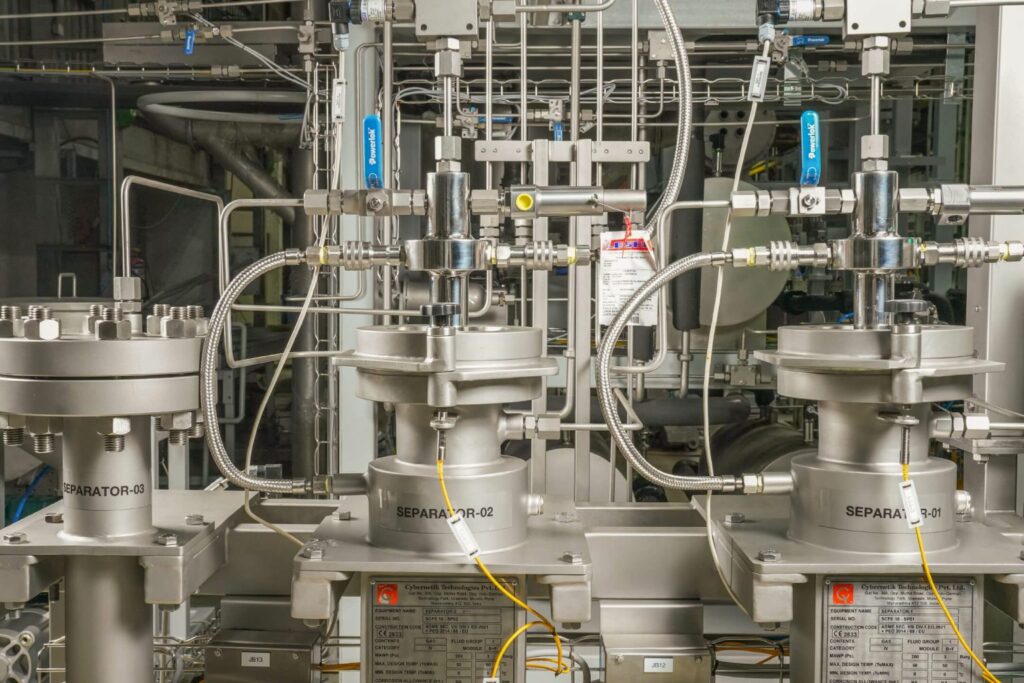
An ASME certified CO2 extractor carries the U-stamp on each pressure vessel individually - not a single certification covering the whole system. Where a complete extraction system contains multiple vessels (extraction vessel, separator 1, separator 2, CO2 accumulator), each vessel is independently U-stamped. The U-stamp tells buyers three things: the vessel design was reviewed for code compliance; an Authorized Inspector witnessed critical fabrication steps; and a Manufacturer's Data Report documenting the as-built condition exists.
What the U-stamp does not cover: the extraction system as a whole, electrical safety, explosion protection, or process control system safety. In the US, state registration of the vessel with the relevant pressure vessel authority is typically required separately from the ASME fabrication process - registration is a state-level administrative step, not part of the ASME certification itself.
ASME Extraction Pressure Vessel Inspection: Ongoing Requirements After Commissioning
ASME extraction pressure vessel inspection does not end when the U-stamp is applied. Most US state pressure vessel laws require periodic in-service inspection by an Authorized Inspector at intervals defined by the National Board Inspection Code (NBIC) or state-specific rules. Internal inspection intervals for unfired pressure vessels typically range from five to ten years depending on service severity, though operating conditions, fluid service, and jurisdictional requirements affect the applicable interval. At each inspection, the Authorized Inspector assesses for corrosion, erosion, cracking, mechanical damage, and fitness for continued service.
ASME extraction pressure vessel inspection integrates with the broader machine maintenance programme for the extraction facility - contamination prevention and downtime-avoidance practices that high-volume extraction operations require are the operational environment in which periodic pressure vessel inspection occurs. A well-documented maintenance programme supports inspection readiness and provides the inspection history that NBIC and jurisdictional authorities expect to see when assessing continued fitness for service.
ASME Extraction Equipment Safety: Scope and Limits
ASME extraction equipment safety standards cover pressure-bearing components only - not the whole system. They do not address electrical safety, explosion protection of equipment in hazardous areas, or process safety management. Complementary standards apply in parallel: NFPA codes govern flammable solvent handling; OSHA Process Safety Management (29 CFR 1910.119) applies to facilities handling flammable liquids above threshold quantities. For facilities selling extraction equipment or products into the EU, CE marking under applicable European directives is the parallel market entry requirement.
Buyers evaluating ASME certified extraction equipment should approach procurement with the same structured framework applicable to any equipment investment decision - capacity requirements, documentation completeness, long-term maintenance access, and total cost of ownership alongside the specific certification status of individual pressure components. The U-stamp documentation package - Manufacturer's Data Report, National Board registration, hydrostatic test records - should be requested and reviewed before equipment acceptance, not collected post-installation.

Where Buffalo Extraction Systems Fits In
Buffalo Extraction Systems extraction equipment is CE, ASME, and PED certified; cryo-ethanol systems also ATEX certified; supplied with GMP documentation (USFDA, Health Canada, EU-GMP as required). This spans CO2 SCFE at 5L×2, 25L×2, and 100L×2 configurations and cryo-ethanol systems at 5 kg, 20 kg, and 50 kg per batch. Each system runs SCADA that records instrument readings continuously throughout every batch, producing a time-stamped process record tied to the calibration state of the temperature sensors, pressure transducers, and flow meters feeding it. For a GMP calibration extraction facility, that relationship is foundational: the SCADA batch record is only as reliable as the instruments behind it, which is why calibration programme integrity is a prerequisite for meaningful process documentation rather than a parallel administrative requirement.
Conclusion
ASME extraction equipment standards set the design, fabrication, and inspection baseline for pressure vessels in CO2 and ethanol extraction systems operating in the United States. The U-stamp on an ASME code extraction system documents code-compliant fabrication verified by an Authorized Inspector - but it covers mechanical integrity only. Electrical safety, explosion protection, EU market entry, and ongoing in-service inspection are handled by complementary standards. ASME certified extraction equipment buyers should treat the U-stamp as the pressure integrity confirmation and build their full compliance programme from there.
Frequently Asked Questions
What does the ASME U-stamp mean on an extraction pressure vessel?
The ASME U-stamp on an extraction pressure vessel indicates the vessel was designed, fabricated, inspected, and tested to ASME BPVC Section VIII Division 1 requirements. The manufacturer holds an ASME Certificate of Authorization to apply the U-stamp; an Authorized Inspector from a recognised Authorized Inspection Agency verifies code compliance during fabrication and witnesses the hydrostatic test before the stamp is applied. A Manufacturer's Data Report documenting the as-built condition accompanies every U-stamped vessel.
Is ASME certification required for extraction equipment in the United States?
In most US states, pressure vessels operating above threshold pressures (typically 15 psi) must be fabricated to ASME BPVC Section VIII and registered with the state pressure vessel authority. For extraction systems operating at supercritical CO2 pressures (200–500 bar), ASME BPVC Section VIII compliance is a practical requirement in all US jurisdictions with active pressure vessel inspection programmes. State requirements vary; some states adopt the NBIC directly while others have state-specific rules referencing ASME standards.
Does ASME certified extraction equipment comply with EU requirements?
No. ASME certification does not constitute compliance with EU Directive 2014/68/EU (PED) or EU Directive 2014/34/EU (ATEX). A vessel bearing the ASME U-stamp may also carry CE marking under PED if the manufacturer has separately completed the EU conformity assessment, but the two marks are independent certifications. Equipment sold into the EU must meet EU directive requirements regardless of whether it also holds ASME certification.
How often must ASME extraction pressure vessels be inspected?
In-service inspection intervals are determined by the NBIC, jurisdictional state rules, and the specific service conditions of each vessel. Internal inspection intervals of five to ten years are common for unfired pressure vessels in chemical process service, but the actual interval depends on operating pressure, temperature, fluid corrosivity, and prior inspection findings. The owner-user is responsible for maintaining an inspection programme consistent with the applicable jurisdiction and retaining inspection records.
What is the difference between ASME extraction equipment safety and process safety?
ASME extraction equipment safety standards cover the mechanical integrity of pressure-containing components - design pressure, material specification, fabrication quality, and in-service inspection. Process safety covers the hazards of the extraction process as a whole: flammable solvent handling, pressure relief system sizing, emergency shutdown, and facility siting. OSHA Process Safety Management (29 CFR 1910.119) requirements apply to facilities handling flammable liquids above threshold quantities - separate from and complementary to ASME vessel certification.