Why Tea Extraction Machine Selection Is a Process Decision, Not a Product One
The global market for industrial tea extraction covers a remarkably wide range of outputs: instant tea powder, ready-to-drink (RTD) concentrate, flavour bases for beverages, solvent-free polyphenol extracts for nutraceuticals, and decaffeinated tea for specialty markets. Each of these outputs requires a different tea extraction machine configuration, and the machine selection decision cannot be made without first defining what the end product is.
This guide is for beverage manufacturers, contract processors, and equipment buyers who need to match a tea extraction machine to an industrial production requirement. It covers the main extraction principles, the equipment types available for the tea manufacturing process, how the tea production process upstream of extraction affects machine selection, and what specification parameters matter most when comparing systems.
The Tea Manufacturing Process Before Extraction
All industrial tea extraction begins with the same upstream reality: Camellia sinensis leaves whose character has been defined by the manufacturing process that precedes the extraction step. Tea production guides explain that the tea manufacturing process determines what path the leaves will take - fermented (black tea), semi-fermented (oolong), or non-fermented (green tea). The first step for black tea is withering, in which leaves are subjected to wilting to enhance flavour compounds and reduce moisture; drying machines are the first step in the tea production line.
The moisture content and particle size of dried tea entering the extraction system determine extraction yield, liquor clarity, and solids concentration in the output. Industrial tea extraction operators who control their own drying and milling stage have a direct lever on those variables; those buying in pre-processed leaf have to accept the variability of their supplier’s process.
For manufacturers who process their own leaf before extraction, the pre-processing line matters: a belt dryer operating at 65–70°C with humidity sensing to 8–10% moisture target, a threshing and sifting step to remove stems and foreign matter, and a VSD-controlled fine grinder for the particle size needed by the downstream extractor. The VSD setting (2,000–4,000 RPM adjustable) lets the operator tune particle size to the extraction method.
Industrial Tea Extraction Methods: Principles and Machine Types
Method | Conditions | Output | Suited To |
Hot water extraction | 80–100°C, atmospheric pressure | Tea liquor; high solids for concentration | Instant tea powder; RTD concentrate; flavour bases |
Cold water extraction (cold brew) | Ambient to 4°C, extended contact time 8–24 hrs | Smooth, lower-bitterness concentrate | Premium RTD cold brew; specialty beverages |
Continuous countercurrent extraction | High temperature, continuous flow through column | High yield liquor; high throughput | Large-scale instant tea production |
CO2 supercritical extraction | ~40°C, 200–350 bar, oxygen-free | Polyphenol/catechin concentrate; decaffeination | Nutraceutical extracts; food-grade actives; residue-free output |
Ethanol extraction | Ambient to mild heat, food-grade ethanol | Flavanol-rich extract; concentrated polyphenols | Speciality beverage actives; supplements |
Industrial tea extraction is a controlled process targeting all soluble compounds to produce a refined liquor. Industry process analysis confirms that unlike domestic brewing, industrial extraction prioritises repeatability, liquor clarity, and downstream process stability. Achieving these outcomes depends heavily on well-engineered sieving and filtration systems that function as core process controls rather than auxiliary equipment - the solid–liquid separation immediately after extraction is as important as the extraction vessel itself.

Selecting a Tea Extraction Machine: Key Specification Parameters
When evaluating a tea extraction machine for industrial production, the following parameters determine whether the system matches the production requirement:
- Extraction temperature range - defines the flavour and compound profile. Cold brew machines operate at ambient to 4°C; hot-water systems at 80–100°C; CO2 systems at around 40°C. The tea manufacturing process target dictates this first.
- Throughput and batch vs continuous operation - batch extractors suit variable-recipe production and premium outputs; continuous countercurrent systems suit high-volume instant tea and RTD concentrate production.
- Concentration capability - most tea extraction machines produce a liquor that requires further concentration (vacuum evaporation) before spray-drying to instant tea or filling as RTD concentrate. Some integrated systems include the concentration step.
- Filtration and solid–liquid separation - spent leaf removal, coarse particle filtration, and fine polish filtration all require their own equipment stages after the extractor. Machine selection must account for the full line, not just the extractor vessel.
- Sanitary design - SS304 contact surfaces, cleanable-in-place (CIP) design, and food-grade seals are required for a tea extraction machine producing a food or beverage ingredient.
- Automation and parameter control - industrial production requires documented, repeatable extraction parameters (time, temperature, tea-to-water ratio) for batch records and consistent output specification.
Vietnam tea production, one of the world’s significant tea-producing regions, illustrates the Vietnam tea production process upstream consideration: green tea leaves from Vietnamese highland cultivation are typically dried and graded before export or domestic extraction. Manufacturers establishing Vietnam tea production process-linked extraction lines should account for the leaf moisture variation typical of agricultural supply chains when specifying dryer integration requirements.
CO2 Extraction as a Premium Tea Extraction Machine Option
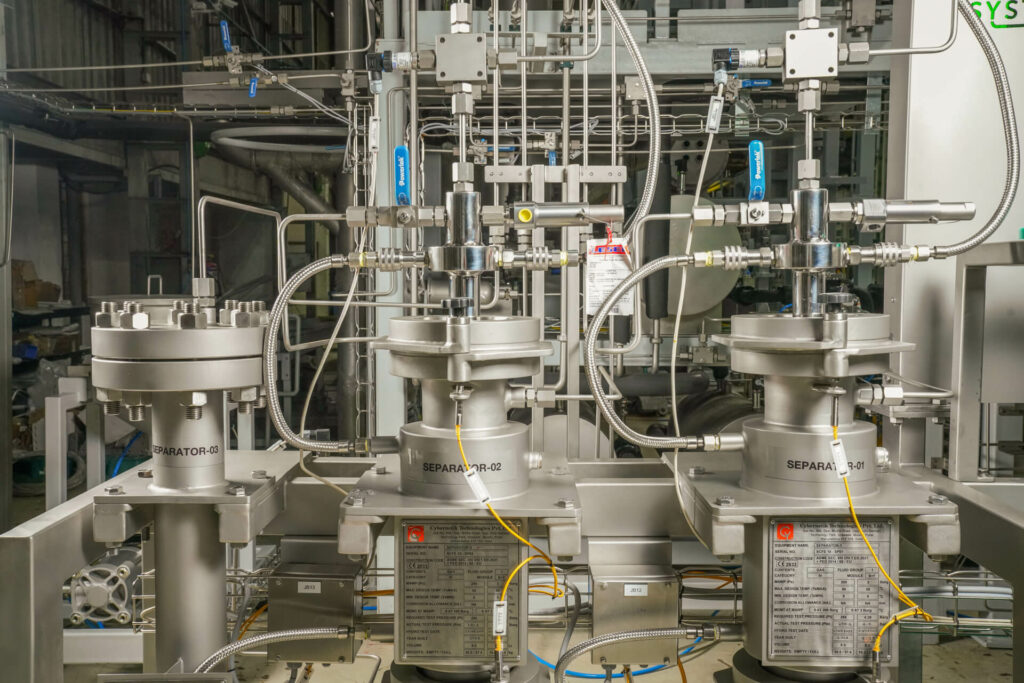
For manufacturers targeting catechin-rich polyphenol extracts, decaffeinated green tea, or residue-free tea actives for nutraceutical applications, supercritical CO2 is the superior tea extraction machine route. Equipment specifications confirm that industrial CO2 tea extraction fluidises carbon dioxide under high pressure through the tea material in adsorption columns, and is suitable for decaffeination techniques. The CO2 operates at low temperature in an oxygen-free environment, preserving catechins and EGCG that degrade under hot-water extraction conditions.
The trade-off is capital cost. CO2 extraction equipment carries a higher purchase price than conventional hot-water or cold-brew extraction tanks. For manufacturers whose product is positioned on polyphenol content, EGCG specification, or solvent-free certification, that cost is justified by the output quality and the regulatory simplification of having no solvent residue to test for.
Where Buffalo Extraction Systems Fits In
Buffalo Extraction Systems manufactures supercritical CO2 extraction systems and conveyorised biomass pre-processing lines for industrial tea processing operations. For manufacturers building a complete tea extraction machine line - from leaf preparation through to concentrated extract or dry polyphenol output - the pre-processing line (drying to 8–10%, threshing, VSD-controlled milling at 2,000–4,000 RPM) feeds correctly prepared leaf to the CO2 extractor. The CO2 system then produces a polyphenol-rich, residue-free extract at low temperature. The output is suited to RTD beverages, instant tea formats, nutraceutical capsules, and cosmetic applications. See supercritical CO2 extraction equipment for high-purity botanical output and CO2 extraction vs cold-pressed methods.
- Three pre-processing scales: 200, 500, and 1,000 kg/hr dry output - pilot to industrial tea leaf preparation.
- Rotronic XB20 humidity sensor and 65–70°C dryer ceiling - precise moisture control before the extraction stage.
- SS304 food-grade contact surfaces throughout - sanitary construction required for food and beverage ingredient production.
- Vacuum packing at filling station - protects catechin content from oxidation during storage and transit of the finished extract.
Conclusion
Selecting a tea extraction machine starts with the end product, not the equipment catalogue. Hot water extraction optimises yield and throughput for instant tea and RTD concentrate; cold brew machines preserve smoothness and reduce bitterness in premium beverages; supercritical CO2 extraction delivers the highest polyphenol concentration and purity for nutraceutical and speciality beverage applications. The tea manufacturing process upstream of the extractor - leaf moisture, particle size, and stem removal - determines whether the extraction system can reach its design output specification. For manufacturers who control their own pre-processing, that upstream quality is the most direct lever on extraction performance.
Frequently Asked Questions
What types of tea extraction machines are used industrially?
The main types are hot-water extractors (for instant tea powder and RTD concentrate), cold-brew extraction tanks (for smooth, low-bitterness premium concentrates), continuous countercurrent extraction systems (for high-volume instant tea), and supercritical CO2 extraction systems (for polyphenol-rich nutraceutical extracts and decaffeinated tea). Integrated systems combine extraction with concentration (vacuum evaporation) and may include solid–liquid separation as a built-in stage.
What is the tea manufacturing process before extraction?
For black tea: withering (moisture reduction and flavour development), rolling, oxidation, and drying. For green tea: steaming or pan-firing to prevent oxidation, then rolling and drying. For extract production, dried leaf then undergoes further particle-size reduction before the extraction stage. The moisture content and particle size of the dried leaf entering the extraction system directly affect yield, liquor clarity, and polyphenol concentration.
What is the difference between hot-water and cold-brew tea extraction for industrial production?
Hot-water extraction (80–100°C) achieves higher solids yields and faster throughput, suited to instant tea powder and large-volume RTD concentrate. Cold-brew extraction at ambient or refrigerated temperatures produces a smoother, less bitter concentrate over 8–24 hours, suited to premium RTD cold-brew beverages. The flavour compound profiles differ significantly between the two methods.
Why use CO2 extraction for industrial tea processing?
Supercritical CO2 extraction operates at around 40°C in an oxygen-free environment, preserving catechins and EGCG that degrade under hot-water extraction. It produces zero solvent residue and achieves high selectivity for lipophilic compounds, suited to polyphenol concentrates for nutraceuticals, decaffeinated tea, and cosmetic-grade actives. The trade-off is higher equipment capital cost versus conventional extraction systems.
What specification parameters matter most when selecting a tea extraction machine?
The key parameters are extraction temperature range (determines compound profile), batch versus continuous operation (determines throughput and recipe flexibility), concentration capability (whether the system includes a downstream concentration step), solid–liquid separation design (critical for liquor clarity), sanitary construction (SS304 contact surfaces and CIP capability), and automation level (for repeatable batch records). All should be evaluated against the specific output product, not against a generic tea extraction benchmark.