The essential oil market is evolving. Buyers in food flavouring, fragrance, pharmaceuticals, and natural cosmetics are increasingly distinguishing between conventionally distilled essential oils and CO2-extracted oils - and for good reason. The method of extraction fundamentally determines the chemical profile, aromatic fidelity, and application suitability of the final product. The CO2 extraction method for essential oils is now a reference point for quality in fine fragrance development and pharmaceutical ingredient production.
CO2 Extraction vs. Steam Distillation: The Quality Difference
Criteria | Supercritical CO2 Extraction | Steam Distillation |
Processing temperature | 35–60°C | 100°C+ |
Heat-sensitive compound retention | ✓ Full preservation | ✗ Partial/significant loss |
Non-volatile compounds captured | ✓ Yes (gingerols, piperine, curcuminoids) | ✗ No |
Solvent residue | Zero | None |
Aromatic fidelity to raw material | Very high | Moderate |
Output types | Essential oil + oleoresin (single run) | Essential oil only |
Scalability | Lab to industrial | Lab to industrial |
Food/pharma compliance | GMP, GRAS, CE, ASME | GRAS only |
Research published in LWT - Food Science and Technology (Elsevier) demonstrated that supercritical CO2 extraction preserves 18–34% more bioactive terpene content in spice matrices compared to steam distillation. A further study in the International Journal of Food Properties confirmed that CO2-extracted black pepper retains piperine concentrations up to 40% higher than steam-distilled counterparts. Many of the most valuable aromatic compounds in botanical raw materials are thermolabile - they degrade or transform when exposed to the elevated temperatures required for steam distillation.
CO2-se Spice Extract: Chemical Composition Reference
Source: Buffalo Extraction Systems Technical Specification Sheets (CO2-se Extracts)
Extract | Scientific Name | EO Content | Key Marker Compounds | Shelf Life |
Cardamom | Elettaria cardamomum | 80–95% | Alpha-terpinyl acetate (30–45%), 1,8-Cineole (20–35%) | Min. 5 years |
Cinnamon Ceylon | Cinnamomum verum | 72–92% | Trans-Cinnamaldehyde (55–75%), Eugenol (3–10%) | Min. 4 years |
Black Pepper | Piper nigrum | 40–65% | Piperine (35–50%), Beta-caryophyllene, Limonene | Min. 5 years |
Ginger | Zingiber officinale | 15–30% | Zingiberene, Bisabolene, Gingerols (5–25%) | - |
Turmeric | Curcuma longa | - | Total Curcuminoids (4–10%), Turmerones (20–35%) | Min. 3 years |
Clove | Syzygium aromaticum | - | Eugenol, Beta-caryophyllene | - |
Fennel | Foeniculum vulgare | - | Trans-Anethole, Fenchone, Limonene | - |
CO2 Essential Oil Extraction Equipment: Key Selection Criteria
When evaluating supercritical CO2 extraction equipment for essential oil applications, buyers should assess the following:
- Pressure and temperature range: The CO2 extraction method for essential oils typically operates at moderate pressures (100–300 bar) for spice essential oils; resins and oleoresins may require higher pressures. Equipment with a broad operating envelope gives operators the flexibility to work across multiple botanicals on a single machine.
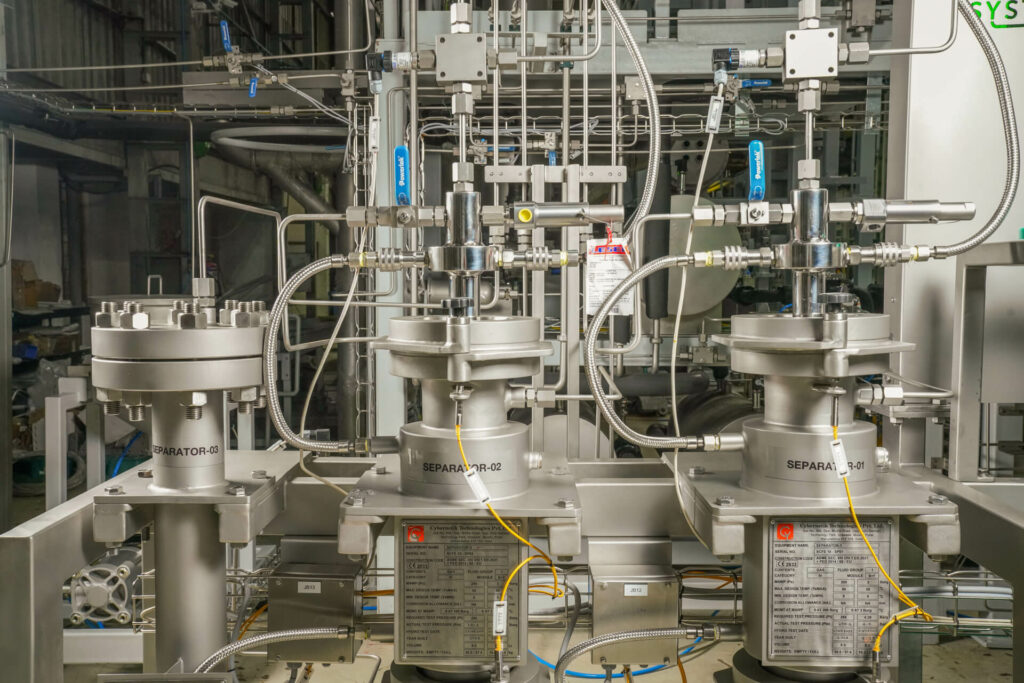
- Separator design and fractionation capability: Multiple separator stages at different pressures allow separation of the lighter essential oil fraction from the heavier oleoresin fraction in a single extraction run. This directly multiplies the commercial value of each batch.
- CO2 recirculation efficiency: Systems with high CO2 recirculation rates - recovering and reusing supercritical CO2 within the extraction cycle - deliver substantially lower per-batch solvent costs and align with sustainability commitments.
- Scalability: Laboratory and pilot-scale systems are appropriate for process development and small-batch premium production. Industrial-scale production requires equipment sized to support continuous operation at meaningful throughput.
Market Size and Investment Context for Essential Oil Producers
According to Grand View Research, the global essential oils market was valued at USD 11.5 billion in 2023 and is forecast to grow at a CAGR of 7.5% through 2030. A 2021 review published in Molecules (MDPI) confirmed that CO2-extracted essential oils from spices consistently show superior chemical complexity, terpene retention, and shelf stability compared to steam-distilled equivalents. The CO2 extraction of essential oils occupies the premium tier of this market - commanding higher prices and addressing buyer requirements that steam-distilled equivalents cannot meet. For manufacturers looking to position in this premium segment, our guide on supercritical CO2 extraction equipment for high-purity essential oils provides further technical detail. For how CO2 extraction is specifically used for essential oils, see CO2 extraction for essential oils. For a full view of which essential oils are in greatest commercial demand, see which essential oils are in great demand.
FAQs
Q: What is CO2 extraction of essential oils, and how does it differ from steam distillation?
A: The CO2 extraction of essential oils uses supercritical carbon dioxide at 35–60°C to pull aromatic compounds without heat damage. Steam distillation at 100°C+ degrades thermolabile molecules, producing a less complete aromatic profile.
Q: What essential oils are best suited to CO2 extraction?
A: Heat-sensitive botanicals benefit most - ginger, black pepper, cardamom, cinnamon, clove, and turmeric all yield superior CO2 extracts that retain non-volatile bioactives (gingerols, piperine, curcuminoids) absent from distilled oils.
Q: What does CO2 essential oil extraction equipment need to include for commercial production?
A: Essential features include precise pressure and temperature control, multiple separator stages for fractionation, a co-solvent dosing system, CO2 recirculation, and GMP/CE/ASME/ATEX certification.
Q: Are CO2-extracted essential oils safe for food use?
A: Yes - CO2 is GRAS-certified by the U.S. FDA, leaves zero residual solvent, and is fully compatible with food-grade and pharmaceutical product requirements.
Q: How much does CO2 extraction equipment for essential oils cost?
A: Lab/pilot systems range from USD 50,000–250,000; industrial-scale systems with full certification typically range from USD 500,000 to several million, evaluated against premium extract pricing and 15–20+ year equipment lifespan.
Q: Can one CO2 extraction machine produce both essential oils and oleoresins?
A: Yes - multiple separator stages at different pressure levels allow simultaneous collection of the lighter essential oil fraction and the heavier oleoresin fraction from a single extraction run.