The supercritical CO2 extraction process uses carbon dioxide, held above its critical point, as a tunable solvent that pulls target compounds out of botanical material and then leaves behind no residue. It has become the reference method for producers who need clean-label, high-purity extracts without the chemical solvents that older methods depend on. This explains how SCFE works from first principles: what it is, the pressure and temperature parameters that govern it, how those settings change the result, and where it is used across the nutraceutical, spice, food, and pharmaceutical industries.
What is supercritical CO2 extraction?
Supercritical CO2 extraction, also written as Supercritical Fluid Extraction (SCFE), is a separation process that turns carbon dioxide into a supercritical fluid and uses it to dissolve and carry selected compounds out of a raw material. A supercritical fluid sits between a gas and a liquid: it flows through packed biomass like a gas but dissolves compounds like a liquid. Because carbon dioxide returns to a gas at ambient conditions once the pressure is released, the extract comes out solvent-free, with no residual solvent to remove downstream.
The method is prized for two reasons. It preserves heat-sensitive and volatile compounds that distillation can degrade, and it is selective, meaning the operator can target one fraction of a material while leaving others behind.
Reaching the supercritical state: the critical point
Carbon dioxide becomes supercritical above roughly 31 degrees C and 74 Bar. Past that threshold, it develops the density and solvating power needed to dissolve oils, resins, and actives. Industrial systems do not run at that minimum, however. Buffalo Extraction Systems (BES) operates its supercritical CO2 systems at either 350 Bar or 600 Bar, with the maximum extraction temperature matched to the pressure: 70 degrees C at 350 Bar and up to 110 degrees C at 600 Bar.
Running well above the critical point is what gives the process its range. Higher pressure raises CO2 density, which increases how much material the fluid can dissolve and lets a single platform handle everything from delicate aromatics to heavier resins.
How the supercritical CO2 extraction process works, step by step
The process runs as a closed loop, so the same carbon dioxide is used again and again rather than vented. In sequence, the stages are:
- Carbon dioxide is pumped and pressurised until it reaches the supercritical state at the set pressure and temperature.
- The supercritical CO2 flows through an extraction vessel packed with milled, correctly sized biomass, dissolving the target compounds. Consistent particle size from proper pre-processing keeps this stage even and repeatable.
- The compound-laden CO2 passes through pressure-regulator valves into a cascade of separators, typically two, each held at its own pressure.
- As pressure drops in each separator, the CO2 loses solvating power and releases its compounds, so heavier and lighter fractions collect in different vessels. This fractionation happens inside the run rather than as a separate
post-processing step. - The stripped carbon dioxide is condensed back to a liquid, stored, and recirculated to the pump to begin the next cycle.
The parameters that control supercritical fluid extraction
Four settings do most of the work in the supercritical CO2 extraction process, and understanding them is what separates a consistent operation from a variable one. The core supercritical fluid extraction parameters are pressure, temperature, CO2 flow rate, and co-solvent.
Pressure is the primary lever. At 350 Bar the fluid is selective and gentle, suited to aromatic and heat-sensitive fractions; at 600 Bar its higher density dissolves heavier resins and waxes and lifts overall yield. Temperature works alongside it, set to 70 degrees C at 350 Bar or up to 110 degrees C at 600 Bar on BES systems, so getting the CO2 extraction temperature and pressure right is the foundation of a repeatable result.
CO2 flow rate governs throughput and contact time, and it is matched to vessel size, ranging across the BES line from 45 litres per hour on the smallest system to 2,000 litres per hour on the largest. A polar co-solvent such as food-grade ethanol can be added in small amounts to reach more polar compounds that pure CO2 cannot dissolve efficiently. Biomass particle size and moisture, set during milling and drying, determine how freely the fluid moves through the bed.
How changing CO2 pressure affects what is extracted
Pressure and temperature together decide not just how much you extract but what you extract. Lower pressure favours light, volatile fractions such as essential-oil aromatics, while higher pressure brings across heavier oleoresins, colours, and lipids. Because each separator downstream can be held at a different pressure, a single run can split a material into distinct fractions, capturing a clean aroma cut in one vessel and a heavier resin in the next.
This tunability is the core advantage of the method. The same system can be tuned by recipe to produce a delicate floral extract one day and a dense spice oleoresin the next, without changing the equipment.
What compounds and industries supercritical CO2 extraction serves
Supercritical CO2 extraction is used wherever purity and a clean label matter. Common non-cannabis applications include:
- Spice oleoresins such as turmeric and curcuminoids, black pepper and piperine, ginger and gingerols, cardamom, clove, and capsicum.
- Essential oils and aromatics for the flavour and fragrance industry, including vanilla, saffron, and citrus.
- Nutraceutical actives including omega-3 concentrates, astaxanthin, rosemary carnosic acid, and specialty seed oils.
- Natural colours such as paprika and annatto, decaffeinated coffee and tea, dewaxed edible oils, and cosmetic actives.
Buyers in these sectors, from nutraceutical and pharmaceutical manufacturers to spice extractors and fragrance houses, choose the process because it delivers a residue-free extract that stands up to regulatory and clean-label scrutiny.
Supercritical CO2 versus solvent extraction
The advantages of supercritical CO2 over hydrocarbon or ethanol solvent extraction are consistent across applications. The extract is solvent-free, so there is no residual-solvent removal step and no residual-solvent risk in the finished product. The lower operating temperatures protect heat-sensitive actives and volatile aromatics that steam distillation can damage. The process is tunable by pressure and temperature, giving selectivity that fixed-solvent methods cannot match, and the closed-loop design recycles the carbon dioxide rather than consuming and disposing of litres of solvent per batch.
The trade-off is that supercritical systems are engineered pressure equipment and carry a higher upfront investment than a simple solvent setup. For producers selling into regulated or premium markets, that cost is usually offset by higher extract value, lower consumable spend, and easier compliance.
Scaling from lab to industrial production
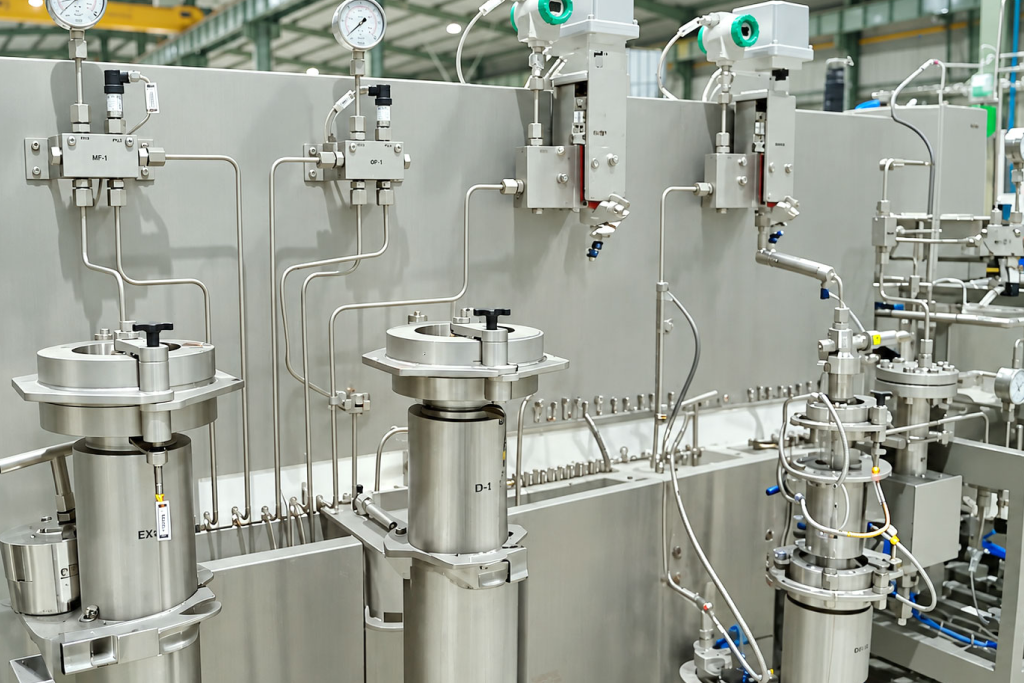
The supercritical CO2 extraction process scales without changing its fundamentals, which lets producers prove a product at small scale and then move to volume on the same principles. BES builds extraction vessels at 5, 10, 25, 100, and 300 litres, each available in two-extractor or three-extractor configurations so throughput can grow with demand. A pilot programme might start on a lab-scale CO2 extraction system and move up to a production line once the recipe is locked.
Across every size the platform keeps the same closed-loop CO2 recirculation, dual-separator fractionation, and SCADA (Supervisory Control and Data Acquisition) recipe control, so parameters validated at pilot scale transfer directly to production.
Build quality and compliance
BES supercritical CO2 systems are built with SS316 stainless steel on all product-contact surfaces and SS304 on non-contact surfaces, with a mirror-finish contact surface suited to GMP production. Each system runs on SCADA with storage for up to 100 recipes and a 15-inch operator interface, and the control system is designed to 21CFR Part 11 and EU-GMP Annex 11 for computerised-system compliance.
Pressure and safety certifications including PED, ASME, ATEX, and CE are available as configured options, specified and declared at the purchase-order stage rather than assumed as standard. This lets each buyer match the certification package to the market they sell into.
Why producers choose Buffalo Extraction Systems
Buffalo Extraction Systems designs and builds supercritical CO2 systems for producers who need to move from a proven recipe to reliable commercial output. Every system is manufactured in-house with the engineering depth of parent company Cybernetik Technologies, which gives buyers a single point of accountability from design through commissioning rather than a chain of separate vendors to coordinate.
The platform is built to scale with the business, from lab and pilot vessels to 300-litre production systems, all sharing the same closed-loop CO2 recirculation, dual-separator fractionation, and SCADA recipe control. Construction is SS316 on contact surfaces with GMP-ready finishes, and the control system is designed to 21CFR Part 11 and EU-GMP Annex 11, so the same equipment supports both R&D and regulated production.
Beyond the machine, BES delivers installation, operator training, standard operating procedures, and after-sales support, and can extend to full GMP facility and process design for producers building from the ground up. That turnkey scope is what lets a first-time extractor and an established manufacturer both reach consistent, compliant output on the same platform.
Conclusion
The supercritical CO2 extraction process gives producers a clean, tunable, and scalable way to recover high-value compounds without chemical solvents. Its results are governed by a small set of parameters, chiefly pressure and temperature, and mastering those settings is what turns the method into a repeatable commercial process. For nutraceutical, spice, food, and pharmaceutical manufacturers working to meet clean-label and regulatory standards, it has become the benchmark approach.
If you are evaluating supercritical CO2 for your material and volume, the next step is to match the parameters and vessel size to your product. Explore CO2 Extraction Systems from Buffalo Extraction Systems, or request a specification for your application.
Frequently Asked Questions
What is supercritical CO2 extraction?
It is a separation process that raises carbon dioxide above its critical point so it behaves as a supercritical fluid, then uses that fluid to dissolve and carry target compounds out of a raw material. When the pressure is released, the CO2 returns to a gas and leaves a solvent-free extract.
What temperature and pressure are used in SCFE?
Carbon dioxide turns supercritical above roughly 31 degrees C and 74 Bar. Industrial BES systems run well above that, at 350 Bar or 600 Bar, with the maximum temperature matched to the pressure: 70 degrees C at 350 Bar and up to 110 degrees C at 600 Bar.
What compounds can supercritical CO2 extract?
It extracts oils, oleoresins, essential-oil aromatics, and actives such as curcuminoids, piperine, gingerols, carotenoids, omega-3 concentrates, and astaxanthin. Adding a small amount of food-grade co-solvent extends its reach to more polar compounds.
How does changing CO2 pressure affect what is extracted?
Lower pressure favours light, volatile fractions such as aromatics, while higher pressure raises CO2 density and brings across heavier oleoresins, colours, and lipids. Holding each separator at a different pressure lets one run split a material into distinct fractions.
What industries use supercritical CO2 extraction commercially?
Nutraceutical and dietary-supplement makers, spice and oleoresin extractors, coffee and tea decaffeination, essential-oil and fragrance houses, food and beverage producers, cosmetics manufacturers, and pharmaceutical producers all use it.
What are the advantages of supercritical CO2 over solvent extraction?
The extract is solvent-free with no residual-solvent removal step, heat-sensitive compounds are better preserved at lower temperatures, the process is tunable for selectivity, and the closed loop recycles the carbon dioxide rather than consuming solvent every batch.