The global cannabis extract market is undergoing a significant transformation. As regulatory frameworks mature and consumer demand for high-purity products intensifies, manufacturers must carefully evaluate which cannabis oil extraction methods align with both their quality standards and production goals. Choosing the wrong method doesn't just affect yield - it affects product safety, compliance, and long-term commercial viability.
Understanding the full landscape of available cannabis extraction methods is no longer optional for serious operators. Whether you're setting up a new facility or scaling an existing one, the extraction method you choose defines everything downstream: potency, purity, residual solvent risk, and regulatory exposure.
Cannabis Oil Extraction Methods at a Glance
|
Method |
Solvent |
Residual Solvent Risk |
Scalability |
Best For |
|
Supercritical CO2 |
CO2 (non-flammable) |
None |
High |
Pharma-grade, full-spectrum, isolates |
|
Cryogenic Ethanol |
Ethanol (flammable) |
Low (with recovery) |
Very High |
High-throughput biomass processing |
|
Hydrocarbon (BHO) |
Butane / Propane |
Moderate–High |
Low–Medium |
Craft concentrates (live resin, shatter) |
|
Rosin Press |
None |
None |
Low |
Artisanal, solvent-free premium products |
|
Cold Press |
None |
None |
Low |
Small-batch, clean-label products |
Supercritical CO2 Extraction
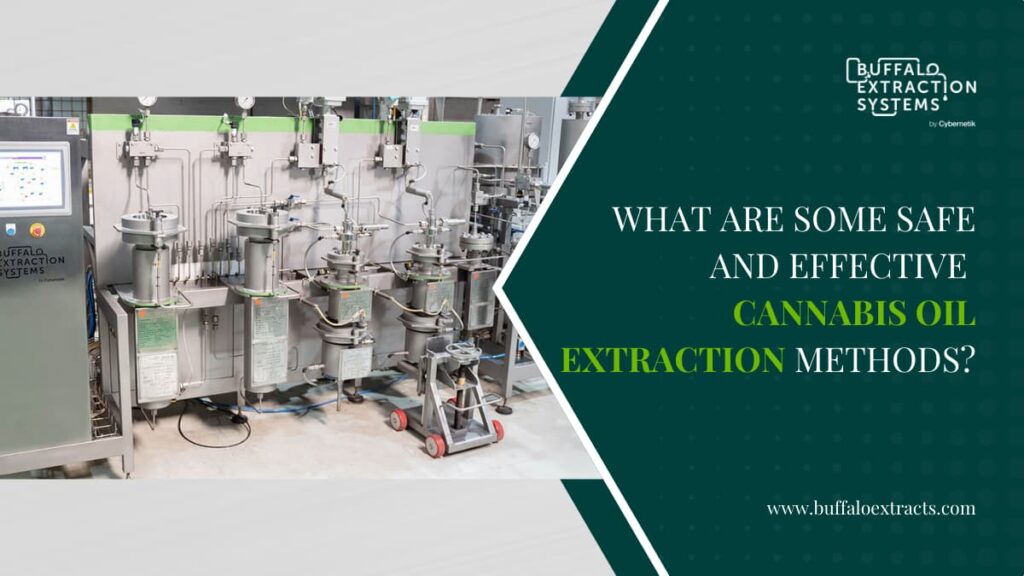
Among all cannabis oil extraction methods, supercritical CO2 extraction has become the industry benchmark for quality-focused manufacturers. CO2 becomes supercritical - exhibiting properties of both a liquid and a gas - when held above 31.1°C and 73.8 bar of pressure. In this state, it acts as a highly selective solvent, capable of isolating specific cannabinoids, terpenes, and other bioactive compounds from plant material with remarkable precision.
The advantages are significant. Because CO2 is a naturally occurring, non-flammable gas, there are no residual solvents in the final extract - a critical requirement for food-grade and pharmaceutical-grade products. Operators can tune pressure and temperature parameters to selectively extract different compound fractions, enabling a single piece of equipment to produce full-spectrum extracts, distillates, or isolated compounds depending on the run configuration.
A 2022 study in Frontiers in Chemistry confirmed that CO2 yields the most complete and stable cannabinoid/terpene profiles across repeated runs compared to all solvent alternatives. Buffalo Extraction Systems' CO2 extraction equipment is GMP-certified, CE-marked, and ASME-compliant, making it suitable for regulated pharmaceutical and nutraceutical manufacturing environments.
Cryogenic Ethanol Extraction
Cryogenic ethanol extraction is another widely adopted approach, particularly valued for its scalability and throughput capacity. By chilling ethanol to temperatures as low as -40°C to -80°C before it contacts plant material, operators dramatically reduce the co-extraction of unwanted compounds like waxes, chlorophyll, and lipids. Research published in the Journal of Industrial Hemp consistently shows that solvent choice remains the single largest determinant of extract purity in commercial cannabis operations. For a detailed breakdown of how cryogenic ethanol compares with supercritical fluid extraction, see our guide on the advantages of cryogenic ethanol extraction vs. supercritical fluid extraction.
This makes cold ethanol extraction well-suited to large-scale operations where processing speed is a priority. However, the flammable nature of ethanol introduces facility design and safety requirements that increase both capital and operational costs. Proper ATEX-rated equipment, explosion-proof electrical systems, and solvent recovery infrastructure are all mandatory components.
Hydrocarbon Extraction (Butane / Propane)
Hydrocarbon solvents - primarily butane and propane - are widely used in craft cannabis operations and concentrate production. As one of the more accessible cannabis extraction methods for small operators, they are highly effective at extracting a broad spectrum of lipophilic compounds, producing popular products such as live resin, budder, and shatter. However, hydrocarbon extraction carries the highest safety risk of any mainstream method, requiring Class 1 Division 1 facilities and rigorous post-processing. According to the U.S. Cannabis Council, solvent residuals remain one of the leading causes of failed laboratory testing in recreational cannabis markets.
Solvent-Free Methods: Rosin and Cold Press
Solvent-free extraction methods - particularly rosin press technology and cold pressing - are gaining traction among artisanal producers and brands emphasising clean-label positioning. Rosin is produced by applying heat and pressure to cannabis flower or hash, causing trichomes to rupture and release a resinous oil. No solvents are involved at any stage. These methods produce inherently solvent-free extracts but generally yield lower volumes and are not easily scalable to industrial production levels.
How to Extract THC Oil at Scale: Key Considerations
For manufacturers specifically focused on how to extract THC oil at industrial volumes, supercritical CO2 and cryogenic ethanol are the two primary scalable options. The decision between them often comes down to several factors:
- Selectivity: CO2 allows precise compound targeting; ethanol is a broader-spectrum solvent
- Safety profile: CO2 is non-flammable and produces zero solvent residue; ethanol requires flammability controls
- Capital investment: Both require high upfront costs, but CO2 systems eliminate solvent recovery infrastructure at the back end
- Regulatory compliance: CO2 extracts are more easily positioned for pharmaceutical and nutraceutical applications
Understanding how to extract THC oil in a way that meets both potency and regulatory requirements is one of the most consequential decisions in cannabis manufacturing. Operators considering full-spectrum products should also review our guide on the
entourage effect and the merits of full-spectrum cannabis products to understand how the extraction method choice directly impacts end-product clinical and commercial value.
CO2 vs. Cryogenic Ethanol: Head-to-Head for THC Oil Production
|
Factor |
Supercritical CO2 |
Cryogenic Ethanol |
|
Operating temperature |
35°C–60°C |
-40°C to -80°C |
|
Solvent residue |
Zero |
Requires recovery/stripping |
|
Flammability |
Non-flammable |
Highly flammable (ATEX required) |
|
Compound selectivity |
High (tuneable by pressure) |
Broad-spectrum |
|
Throughput |
Medium–High |
Very High |
|
Post-processing steps |
Minimal |
Winterisation often needed |
|
Pharma/nutraceutical suitability |
Excellent |
Good |
|
Equipment certification |
GMP, CE, ASME, ATEX |
GMP, ATEX, explosion-proof |
Selecting the Right Extraction Method
There is no single best cannabis oil extraction method. Evaluating all available cannabis extraction methods against your specific production requirements is the only way to make a sound capital decision. According to Grand View Research, the global cannabis extract market was valued at USD 4.8 billion in 2023 and is projected to grow at a CAGR of 16.8% through 2030. For operators evaluating their options, see our guide on scaling from lab to industrial CO2 extraction equipment to understand how equipment selection aligns with production goals and compliance requirements.
FAQs
Q: What is the best cannabis oil extraction method for commercial production?
A: Supercritical CO2 extraction is the industry benchmark - it produces solvent-free extracts, enables precise compound targeting, and meets GMP, CE, and ASME compliance requirements.
Q: What is the difference between cannabis oil extraction and THC oil extraction?
A: Cannabis oil extraction covers all bioactive compounds (CBD, THC, terpenes); knowing how to extract THC oil specifically targets delta-9-THC concentration, requiring additional post-processing such as distillation or isolation.
Q: Is CO2 extraction safe for cannabis oil?
A: Yes - CO2 is non-toxic, non-flammable, and leaves zero solvent residue. It is GRAS-certified by the U.S. FDA and eliminates the fire risks associated with hydrocarbon or ethanol methods.
Q: How does hydrocarbon extraction compare to CO2 for cannabis?
A: Hydrocarbon extraction is effective for craft concentrates but carries higher safety and compliance risks - flammable solvents, Class 1 Division 1 facility requirements, and strict residual solvent testing. CO2 is the cleaner, more compliant choice.
Q: Can one extraction method produce both full-spectrum and isolate cannabis oils?
A: Yes. Supercritical CO2 systems produce full-spectrum or isolated outputs simply by adjusting pressure, temperature, and separator staging between runs.
Q: What certifications should I look for in cannabis extraction equipment?
A: Prioritise GMP, CE, ASME, and ATEX certifications - these are the standard compliance requirements for pharmaceutical-grade and regulated cannabis manufacturing environments.