The production economics of ginger extraction are more nuanced than a simple CAPEX comparison suggests. While supercritical CO2 extraction equipment carries higher upfront capital costs than steam distillation or solvent extraction, a complete operational cost analysis - incorporating solvent economics, energy intensity, post-processing burden, waste disposal, regulatory compliance, and per-kilogram bioactive yield - consistently demonstrates lower total cost of production per kilogram of saleable extract. This article provides the first fully structured cost comparison across all commercial ginger extraction methods.
The True Cost of Ginger Extraction: A Multi-Factor Analysis
Most cost comparisons for ginger extraction focus solely on equipment purchase price. The operationally relevant comparison must include all cost drivers that affect the per-kilogram cost of finished extract:
Cost Driver | Steam Distillation | Solvent Extraction | Ethanol Extraction | Supercritical CO2 |
Solvent cost per kg | Low (water/steam) | Medium (hexane) | Medium (ethanol) | Low after recirculation (>95% CO2 recovery) |
Energy cost per kg | High (100°C+) | Medium | Medium | Low-Medium (35–65°C, efficient heat exchange) |
Post-processing (winterisation, etc.) | None needed | Required | Required (filtration) | None required |
Waste disposal cost | Low | High (solvent waste) | Medium | Zero (CO2 → gas) |
ATEX compliance cost | None | Required | Required | Optional (co-solvent only) |
Batch yield per kg input | Low–Medium | Medium–High | Medium–High | High (superior bioactive recovery) |
QC / rejection rate | High (seasonal variability) | Medium | Medium | Low (HPLC-controlled) |
Regulatory compliance cost | Low | High (residue testing) | Medium | Low (zero residues) |
Critical cost insight: Supercritical CO2 extraction's >95% CO2 recirculation efficiency fundamentally changes the solvent economics. Unlike hexane or ethanol, which are partially lost to evaporation, absorbed by biomass, and require waste treatment, CO2 reverts entirely to gas upon depressurisation and is recompressed and reused. This means the ongoing solvent cost per kilogram drops below 5% of total operational cost within 12–18 months of operation, versus 20–35% for hexane-based systems. Our analysis of how high-capacity CO2 recirculation reduces operational costs quantifies this in detail.
Output Value vs. Operational Cost: The CO2 Net Margin Advantage
The cost reduction argument becomes clearest when output value is factored against operational cost per kilogram:
Equipment Level | CAPEX (USD) | Daily Output Value (org. CO2 oleoresin) | Operational Cost/kg (est.) | Net Margin/kg (est.) |
Level 1 (lab 0.5–5 L) | 80K–250K | USD 300–3,000 | USD 30–80/kg | USD 90–200/kg |
Level 2 (pilot 5–50 L) | 250K–800K | USD 3,000–30,000 | USD 20–55/kg | USD 100–225/kg |
Level 3 (industrial 50–500 L) | 800K–3M+ | USD 30,000–300,000 | USD 12–35/kg | USD 115–245/kg |
Reading this table: Level 3 industrial CO2 systems achieve the lowest operational cost per kilogram (~USD 12–35/kg) due to economies of scale in CO2 recirculation and batch throughput. Combined with organic CO2 oleoresin output pricing of USD 150–280/kg, the net margin per kilogram (USD 115–245/kg) is significantly higher than any conventional extraction method operating at the same scale. For ginger extract price calculations, the CO2 premium on output pricing more than compensates for higher CAPEX.

Ginger Extraction Cost Reduction: The Key Operational Levers
For extraction operators specifically managing ginger extraction costs, the following levers provide the greatest impact:
- CO2 recirculation optimization: Achieving >95% CO2 recovery is the single most impactful operational cost lever. Each percentage point of lost CO2 represents direct solvent replacement cost. Modern high-capacity recirculation systems with efficient heat exchangers achieve 95–98% recovery in industrial operation.
- Raw material pre-processing: Drying ginger rhizome to 10–12% moisture before extraction maximises CO2 bioactive transfer efficiency. High moisture content in fresh ginger dilutes CO2 solubility and reduces gingerol yield per extraction run. Pre-processing investment (drying infrastructure) typically yields 15–25% improvement in extraction efficiency.
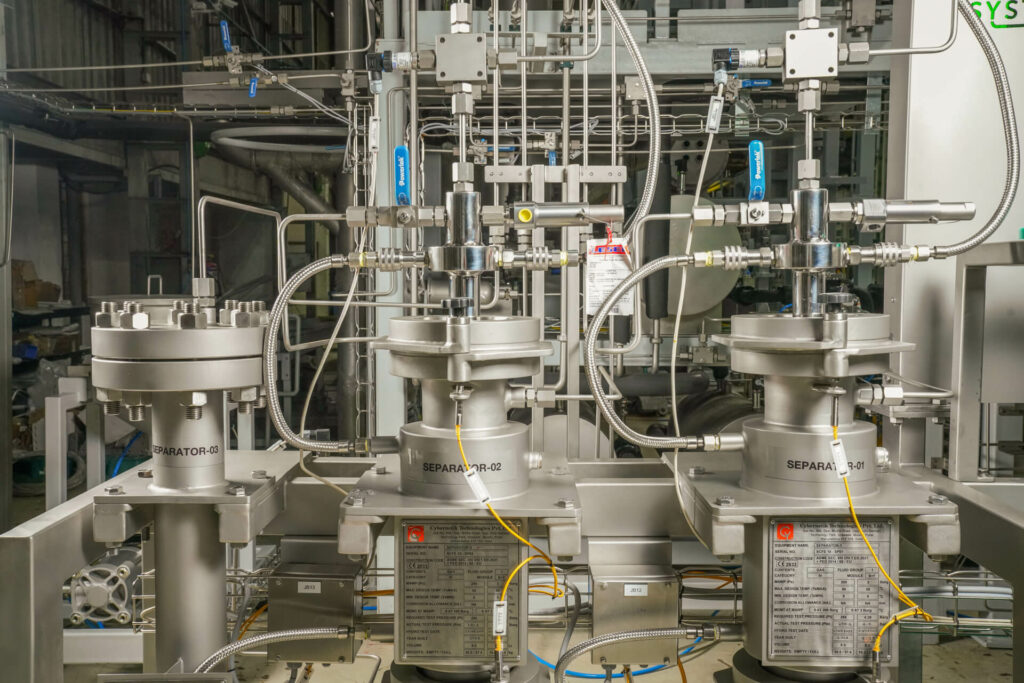
- Multi-stage separator utilisation: Operating multi-stage separators to collect distinct fractions (essential oil at low pressure, oleoresin at high pressure) increases total saleable output per batch - effectively reducing cost per unit of total output value rather than just cost per kilogram of single product.
- Batch sequencing and throughput optimisation: Automated SCADA-controlled batch sequencing minimises vessel downtime between extractions. For ginger extraction, optimised cycle times (2–3 hours extraction + 30–45 minutes vessel changeover) at Level 3 industrial scale maximise daily throughput and amortise fixed costs over more output units. See how operators can optimise extraction cycles.
- Ginger extract liquid formulation efficiency: CO2 ginger root extract liquid's higher bioactive concentration (standardised gingerol content vs. conventional oleoresin) means smaller inclusion levels are needed in finished formulations - reducing per-unit ingredient cost for downstream formulators and making CO2 extract more cost-competitive at the formulation level than raw per-kg pricing suggests.
Global Cost Reduction Impact: Regional Perspective
The cost reduction effect of CO2 extraction is not uniform globally - it varies by regional energy costs, raw material pricing, and regulatory environment. In India - the dominant ginger-producing nation with approximately 40–45% of global ginger supply - the combination of relatively low raw material cost with CO2 extraction creates among the world's most competitive ginger root extract production economics. Indian extraction operators with GMP-certified CO2 systems are positioned to capture both domestic pharmaceutical demand and EU/US export market premium pricing.
Regional CO2 extraction adoption trends are detailed in our analysis of how Asia, Europe, and the USA are driving CO2 extraction growth.
Ginger Extract for Hair and Personal Care: Cost Efficiency at Scale
The personal care segment - particularly ginger extract for hair (scalp stimulation, anti-dandruff, hair growth research applications using α-zingiberene and geraniol) and skincare (anti-ageing creams, serums, shower gels) - represents a rapidly growing secondary revenue stream for ginger CO2 extract operators. The essential oil fraction (15–30% of CO2 extract) that is the primary personal care ingredient is extracted at lower pressures (100–150 bar) with lower energy intensity - making it the most cost-efficient product stream per kilogram of extract value generated. Cosmetic applications of ginger CO2 extract in perfume, deodorants, shower gel, shampoo, and anti-ageing formulations all utilise this lower-cost extraction stage.
Conclusion
The total cost of production for ginger extraction strongly favours supercritical CO2 at the operational level - despite higher CAPEX - through lower solvent costs (>95% CO2 recovery), zero waste disposal, eliminated post-processing, lower energy intensity, higher per-kg bioactive yield, and premium output pricing that widens net margin per kilogram significantly beyond conventional extraction methods. For extraction businesses globally, the question is not whether CO2 extraction is cost-efficient for ginger - it is how quickly the CAPEX can be deployed against a market that is actively rewarding the CO2 premium.
FAQs
Q: How does supercritical CO2 extraction reduce ginger extraction costs compared to solvent methods?
A: CO2 recirculation at >95% recovery eliminates ongoing solvent replacement costs. Zero-waste disposal costs replace high solvent waste management expenses in hexane extraction. No post-processing (winterisation/filtration) is needed. At the industrial Level 3 scale, operational cost per kilogram drops to USD 12–35/kg vs. USD 25–60/kg for hexane extraction, while output pricing for CO2 oleoresin is 3–7x higher.
Q: What is the ginger extract price differential between CO2 and conventional extraction output?
A: CO2 organic ginger oleoresin: USD 150–280/kg. Conventional hexane ginger oleoresin: USD 15–40/kg. Net margin per kilogram: USD 115–245/kg for CO2 vs USD 5–15/kg for conventional - a 10–15x margin advantage that more than compensates for higher CO2 extraction CAPEX within 24–48 months.
Q: How does CO2 recirculation efficiency reduce ginger extraction operational costs?
A: At >95% CO2 recovery, the solvent cost per kg of ginger processed is below 5% of the total operational cost. This compares to 20–35% for hexane-based systems, where solvent losses, waste treatment, and replacement are ongoing expenses. Over a full year of operation, this difference represents hundreds of thousands of USD in operational cost savings at an industrial scale.
Q: What pre-processing steps reduce ginger extraction costs most effectively?
A: Drying ginger rhizomes to 10–12% moisture before CO2 extraction improves extraction efficiency by 15–25%, reducing raw material needed per kilogram of standardised oleoresin output. Grinding to a 1 mm particle size increases surface area and reduces extraction time. Both measures lower the cost per kilogram of finished ginger root extract.
Q: Is ginger extract for hair production cost-effective using CO2 extraction?
A: Yes. Ginger CO2 essential oil for personal care applications (hair care, skincare) is extracted at lower pressures (100–150 bar) with lower energy intensity than oleoresin extraction. This makes it the most cost-efficient product stream per kilogram of output value. The α-zingiberene and geraniol fraction used in ginger extract for hair and scalp applications is extracted as a natural by-product of the lower-pressure first stage.