Why Equipment Qualification Is Not Optional - and How to Get Through It Without Wasting Months
Every regulated extraction manufacturer faces the same bottleneck with IQ OQ PQ extraction equipment qualification: it is required before a single GMP batch can be produced, it takes time most projects never budget for, and the documentation is almost always harder to assemble than expected. FDA guidance on equipment qualification is clear: qualification documentation must be in place before production use. Inspectors do not care that the equipment arrived six months late or cost half a million dollars. No qualification documentation means no GMP production.
This guide explains what IQ OQ PQ extraction equipment qualification actually involves for extraction systems - CO2 extractors, ethanol extraction units, and the pre-processing equipment that feeds them - not pharmaceutical filling lines or analytical instruments. The goal is to help QA teams and production engineers understand exactly what they need to produce, in what order, and where the apparent shortcuts actually cost time.

Hygienic design and cGMP compliance for CO2 extraction covers the equipment design features that make extraction equipment validation IQ OQ PQ achievable from day one - what to confirm before you sign a purchase order.
What IQ OQ PQ Means and Why the Sequence Is Non-Negotiable
IQ OQ PQ extraction equipment qualification is a three-stage process that builds on itself. You cannot run OQ before IQ is complete and signed off. You cannot run PQ before OQ is closed. Each stage answers a fundamentally different question:
- IQ - Installation Qualification: did the right equipment arrive and was it installed correctly? This confirms the equipment is the specified model, installed to the manufacturer's drawings, connected to correct utilities at correct specifications, and that all documentation - manuals, calibration certificates, material certificates for SS316L product-contact surfaces - is in place.
- OQ - Operational Qualification: does the equipment operate within its specified parameter range? This tests the system across its full operating envelope - minimum, target, and maximum values for every critical parameter. Alarms and interlocks are tested and confirmed to function correctly. Every test is documented with the actual result beside the acceptance criterion.
- PQ - Performance Qualification: does the equipment consistently produce the intended output? This runs your actual botanical material at your actual process conditions and confirms the output meets your product specification across at least three consecutive batches. This is the stage regulators care most about.
EU GMP EudraLex Volume 4 Annex 15: Qualification and Validation sets out the qualification and validation framework that applies to pharmaceutical and herbal medicine manufacturers in the EU - the most detailed qualification standard currently in force globally.

IQ: What You Actually Need to Check and Document
Installation qualification is more than a checklist. It must demonstrate with objective evidence that every aspect of the installation meets the design specification. For an extraction system, IQ covers:
- Equipment identity verification: serial numbers, model numbers, and component specifications confirmed against the purchase order. Material certificates (3.1 certificates per EN 10204) for all SS316L product-contact surfaces - reviewed and filed at IQ, not located later when an inspector asks.
- Utility connections: CO2 supply pressure and purity, cooling water flow and temperature, electrical supply voltage and phase, compressed air pressure and quality - each confirmed against the equipment specification and recorded.
- Instrumentation calibration: every temperature sensor, pressure transducer, flow meter, and control instrument must carry a calibration certificate before IQ is signed off. Calibration by an uncalibrated reference instrument is worthless.
- Documentation package completeness: operating manuals, cleaning procedures, spare parts list, drawings, P&IDs - all present, filed, and accessible. If it cannot be found during qualification, it will not be found during an inspection.
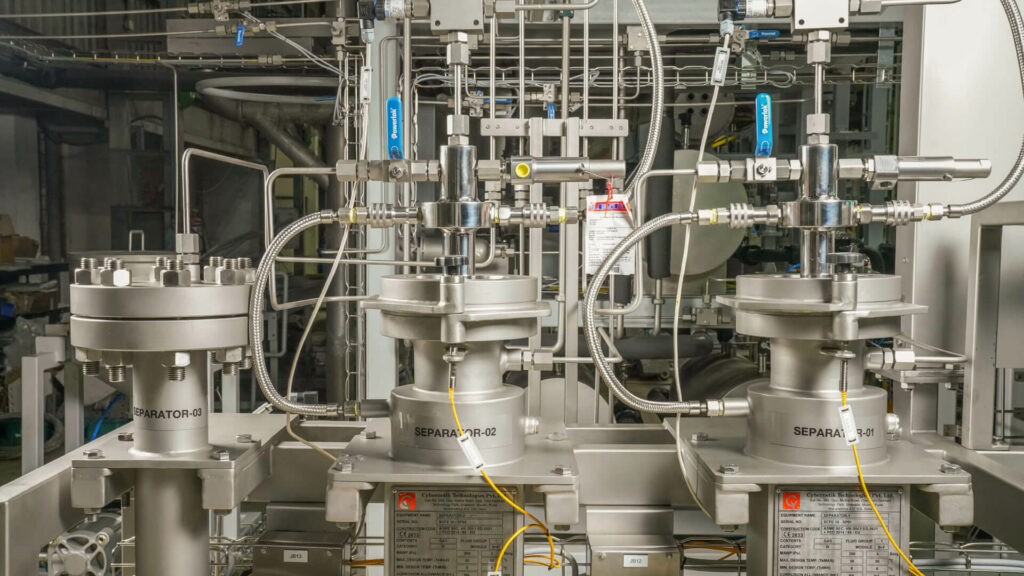
- Safety systems: emergency stops, pressure relief valves, CO2 or solvent detection alarms - confirmed present, functional, and correctly set. For an IQ OQ PQ CO2 extractor, pressure vessel certificates and periodic inspection records are also required.
OQ: Testing the Operating Range, Not Just the Target
The most common operational qualification mistake is testing only at the target operating point - the temperature, pressure, and time parameters planned for production. OQ is supposed to test boundary conditions: what happens at minimum and maximum specification values?
ICH Q2(R1) on analytical method validation applies this same boundary-testing principle to analytical instruments used in QC. The principle is identical for extraction systems: an extraction equipment validation IQ OQ PQ programme that only tests the target condition is a box-ticking exercise that exposes you at PQ - or at inspection. Can the system hold 40°C ± 2°C across the entire vessel volume, or only at the control sensor location? Can it maintain 300 bar ± 5 bar for a full 90-minute run, or does pressure drift outside specification after 60 minutes?
For an IQ OQ PQ CO2 extractor, the OQ parameter matrix typically covers: vessel temperature stability across the full volume at minimum, target, and maximum set points; pressure stability at minimum, target, and maximum over the full extraction duration; CO2 flow rate accuracy at all three set points; separator temperature and pressure stability; and SCADA data logging accuracy - the values the control system records must match the values calibrated reference instruments measure.
PQ: The Stage That Proves Your Process Actually Works
Performance qualification is the stage that separates a qualified GMP extraction system from one that merely operates. It answers the question all the preceding work builds toward: does this equipment, running this process, consistently produce a product that meets this specification?
For botanical extraction, PQ involves running your actual botanical material - same species, same particle size range, same moisture specification - through the extraction system at defined process parameters, and testing the extract output against your full product specification across at least three consecutive batches. All three must pass independently. One failure means the PQ is incomplete; the failure is investigated as a deviation, the root cause resolved, and the failed batch does not count toward the three required passing batches.
The extraction equipment validation protocol for PQ must specify in advance: botanical material specification, process parameters, in-process controls, output specification, and acceptance criteria for the qualification to pass. Writing acceptance criteria after reviewing results is not PQ - it is reverse engineering, and an experienced inspector identifies it immediately from the document dates.
How BES extraction systems support GMP compliance from installation explains the IQ/OQ/PQ documentation packages included with every system and how SCADA data logging generates the process records that PQ requires.
Common Qualification Failures and How to Avoid Them
Failure | Why It Happens | How to Avoid It |
Qualification starts before installation is complete | Production pressure; team starts OQ while utilities are still being connected | IQ sign-off is a formal gate - nothing proceeds until QA countersigns. No exceptions. |
OQ acceptance criteria written after results are seen | No protocol written in advance; limits adjusted to match what the equipment achieved | Write and approve the extraction equipment validation protocol - all acceptance criteria - before any OQ testing. Lock the document. |
PQ run with different material than production will use | Test material was more uniform or easier to process than typical production lots | PQ must use the same source material, particle size, and moisture specification as production. Use a production-representative lot, not a laboratory reference sample. |
Calibration certificates missing at IQ | Instruments shipped without certificates; follow-up never completed | Make calibration certificates a purchase order condition. Verify receipt before IQ commences - not during. |
Only one PQ batch attempted | Time pressure; first batch passes and team closes qualification | Three consecutive passing batches is the regulatory expectation. One passing batch means you got lucky once. |
Scaling extraction from lab to industrial production covers the equipment selection and scale-up decisions that precede qualification - the decisions that determine how straightforward your IQ OQ PQ extraction equipment programme will be.
Manufacturers considering extraction system investment should also review supercritical CO2 extraction equipment for high-purity essential oils for the equipment specifications that determine IQ OQ PQ extraction equipment qualification scope and documentation requirements.
Where Buffalo Extraction Systems Fits In
Buffalo Extraction Systems supplies extraction and pre-processing equipment with IQ/OQ/PQ documentation packages included as standard. Every system is CE certified with calibrated instruments, SS316L product-contact surfaces with 3.1 material certificates, and SCADA control with data logging - the configuration that makes extraction equipment validation IQ OQ PQ straightforward rather than a documentation construction project. Three capacity scales at 200, 500, and 1,000 kg/hr dry output.
Conclusion
IQ OQ PQ extraction equipment qualification is the evidence base that proves your extraction system works as intended before it touches a GMP production batch. Installation qualification catches installation errors. Operational qualification finds boundary condition failures before product runs through the system. Performance qualification confirms that the equipment, process, and product specification work together consistently across three passing batches. The manufacturers who complete extraction equipment validation IQ OQ PQ without wasting months write the protocol before testing, use production-representative material in PQ, and treat every stage as genuine engineering verification - not documentation to complete after the system is already running.
Frequently Asked Questions
What is IQ OQ PQ for extraction equipment?
IQ OQ PQ extraction equipment qualification is the three-stage GMP programme required before production begins. IQ confirms equipment was installed correctly and all documentation is in place. OQ confirms it operates within specified parameter range across minimum, target, and maximum values - with alarms and interlocks tested. PQ confirms it consistently produces product meeting specification over at least three consecutive passing batches using actual production material.
What does IQ OQ PQ involve specifically for a CO2 extraction system?
For an IQ OQ PQ CO2 extractor: IQ covers serial number and material certificate verification, CO2 supply quality and pressure, calibration certificates for all instruments, pressure vessel certification, and safety system testing. OQ tests temperature, pressure, and CO2 flow rate stability across the full operating range. PQ runs the actual botanical feedstock at defined process parameters over three consecutive batches, with output tested against the full product specification.
How long does the IQ stage take for an extraction system?
Installation qualification for a mid-scale extraction system typically takes 3–5 working days, assuming all documentation is available and utilities are connected at the correct specification before IQ begins. The most common delay is missing calibration certificates - instruments shipped without them, follow-up not completed. Building two weeks into the project plan for IQ - including time to obtain missing documentation - is a realistic buffer.
Who writes the qualification protocol and when?
The extraction equipment validation protocol is written and approved by QA before any testing begins - with all acceptance criteria locked before results are seen. It defines what will be tested, how it will be tested, and what results are required for qualification to pass. It cannot be modified to match results after testing. The protocol is typically written collaboratively by QA and the equipment engineer, with the manufacturer's documentation package as the starting template.
Can production begin before PQ is complete?
No. Performance qualification must be completed and signed off by QA before any GMP production batch can be released. Running commercial production on an unqualified extraction system is a critical GMP deficiency under EU GMP, FDA cGMP, and WHO GMP. The regulatory position is unambiguous: the equipment is unqualified until PQ is closed, and product made on it is product made on unqualified equipment.