The global ginger processing industry is not a monolith - it spans fresh rhizome processors, dried spice extractors, organic ginger supplement producers, pharmaceutical API suppliers, and specialty botanical ingredient companies. Each segment works with different types of raw ginger material, targets different end markets, and requires different product specifications. A supercritical CO2 extraction machine is the only single capital investment that can serve every one of these segments - and this technical flexibility is the foundation of its investment case.
Understanding the Different Types of Ginger and Their Extraction Implications
The term 'ginger' encompasses a broader range of botanicals than most industry buyers realize. The extraction output, bioactive profile, and commercial application differ significantly across ginger types. The table below provides a structured overview of the types of ginger commercially relevant to extraction businesses:
Ginger Type / Form | Botanical / Commercial Description | CO2 Extract Output | Primary Market Application | Key Bioactive Profile |
Fresh ginger (green) | Freshly harvested Zingiber officinale rhizome, high moisture | Light essential oil (aromatic) | Premium F&B, wellness shots | High geraniol/neral, lower shogaols |
Dried ginger (sunthi) | Sun-dried or oven-dried rhizome, reduced moisture 10–12% | Full CO2 oleoresin + oil | Supplements, food, pharma | Higher shogaols (from gingerol conversion) |
Baby ginger | Immature rhizome, thin skin, higher water content | Delicate essential oil | Culinary, artisan beverage | Mild gingerol profile, pronounced floral notes |
Mature rhizome ginger | Fully mature, fibrous, high resin content | High-yield CO2 oleoresin | Pharma-grade standardized extract | Maximum gingerol concentration (5–25%) |
Organic certified ginger | Certified USDA/EU/JAS organic rhizome | Organic CO2 essential oil + oleoresin | Organic supplement brands, EU clean label | Same bioactive profile, pesticide-residue-free |
Black ginger (Kaempferia parviflora) | Related species, not Z. officinale | Specialized CO2 extract | Sports nutrition, energy supplements | Polymethoxyflavones (distinct from gingerols) |
Galangal (greater) | Alpinia galanga, related Zingiberaceae | CO2 essential oil | Thai cuisine, Ayurvedic pharma | 1,8-Cineole, terpinene dominant |
Zingiber zerumbet (shampoo ginger) | Ornamental/medicinal ginger species | CO2 zerumbone-rich extract | Anti-inflammatory pharma research | Zerumbone (primary sesquiterpene) |
Key insight: A single supercritical CO2 extraction machine can be reconfigured - by adjusting pressure, temperature, and CO2 flow parameters - to optimally extract each of these ginger types without any hardware change. This cross-raw-material flexibility is a capability no other extraction technology offers at this production quality level.
Why CO2 Extraction Handles All Types of Ginger Better Than Alternatives
Each ginger type presents distinct extraction challenges that a CO2 extraction machine is uniquely equipped to address:
- Fresh ginger (high moisture): The high moisture content of fresh rhizome requires pre-drying before CO2 extraction - standard practice at commercial scale. CO2 extraction of properly dried fresh ginger yields a delicate essential oil with high geraniol and neral content, preserving the bright, fresh aroma that distinguishes premium ginger beverages.
- Dried ginger (higher shogaols): Drying converts a proportion of gingerols to shogaols through dehydration. CO2 extraction of dried ginger therefore produces an oleoresin with a different and commercially valuable bioactive signature - higher shogaol content (0.5–5%) alongside residual gingerols (5–25%). This profile is preferred for pharmaceutical antiemetic and anti-inflammatory supplement formulations.
- Organic ginger: As established, CO2 is the only processing aid universally accepted under EU 2018/848, USDA NOP, JAS, and NPOP organic certification frameworks. Organic ginger businesses that attempt solvent or hexane extraction forfeit their organic certification on the extract. CO2 extraction preserves it in every market.
- Mature rhizome ginger: High resin content in mature rhizomes makes them the highest-yield source for CO2 oleoresin extraction, with gingerol concentrations at the upper end of the 5–25% range. This is the preferred raw material for pharmaceutical-grade standardized ginger supplements.
- Related species (black ginger, galangal): The same CO2 extraction machine, with recipe adjustments, can process related Zingiberaceae species - diversifying the operator's product portfolio without additional capital investment.
The ROI Case: Level-by-Level Investment Analysis
The financial case for a CO2 extraction machine in ginger processing is best understood through a level-by-level analysis matching equipment scale to raw material input and output value:
Investment Factor | Level 1 (Lab) | Level 2 (Pilot) | Level 3 (Industrial) |
Vessel volume | 0.5–5 L | 5–50 L | 50–500+ L |
Processing capacity (dry ginger/day) | 0.5–5 kg | 5–50 kg | 50–500+ kg |
Typical CAPEX range | USD 80K–250K | USD 250K–800K | USD 800K–3M+ |
Output value (organic CO2 oleoresin) | USD 700–6,000/day | USD 7,000–60,000/day | USD 70,000–600,000/day |
Payback period (est.) | 12–24 months | 18–36 months | 24–48 months |
Best suited ginger product | R&D, specialty batches | Contract, branded extract | Pharma API, large-scale supplement |
GMP / ASME / CE certified | Available | Standard | Standard + SCADA |
Note: Output value estimates based on organic CO2 oleoresin pricing of USD 150–280/kg for Level 1/2 and pharmaceutical-grade USD 250–500/kg for Level 3. Actual payback periods depend on capacity utilization, product mix, and market pricing. For detailed scaling analysis, see our guide on scaling from lab to industrial CO2 extraction equipment.
Key ROI observation: Even at Level 1 scale, processing 2–3 kg of dried organic ginger per day into standardized CO2 oleoresin at USD 200/kg output pricing generates USD 400–600 per day in product value from a USD 80K–250K capital investment - a payback trajectory achievable within 12–24 months at moderate capacity utilization.
Ginger Products Output Diversity: One Machine, Many Revenue Streams
Perhaps the most compelling investment argument for a CO2 extraction machine is its ability to generate multiple distinct ginger products from a single piece of equipment - each targeting a different market at a different price point:
- Ginger CO2 essential oil (straw-to-reddish-brown liquid): Warm, spicy aroma, 15–30% essential oil content. Applications: premium food flavoring, functional beverages, cosmetics, perfumery, deodorants, shower gels, anti-aging creams.
- Ginger CO2 oleoresin (darker yellow-to-brown viscous liquid): Total gingerols 5–25%, shogaols 0.5–5%, non-volatile resin fraction 60–85%. Applications: standardized ginger supplements, pharmaceutical formulations, savoury food products, natural preservative for edible oils.
- Full-spectrum CO2 extract: Combined volatile + non-volatile fraction. Applications: functional food fortification, nutraceutical co-formulation, ginger-forward wellness products.
- Organic variants of all above: Commanding 2–7x price premium when organic raw material sourcing and facility certification are in place - same extraction machine, dramatically higher per-kg revenue.
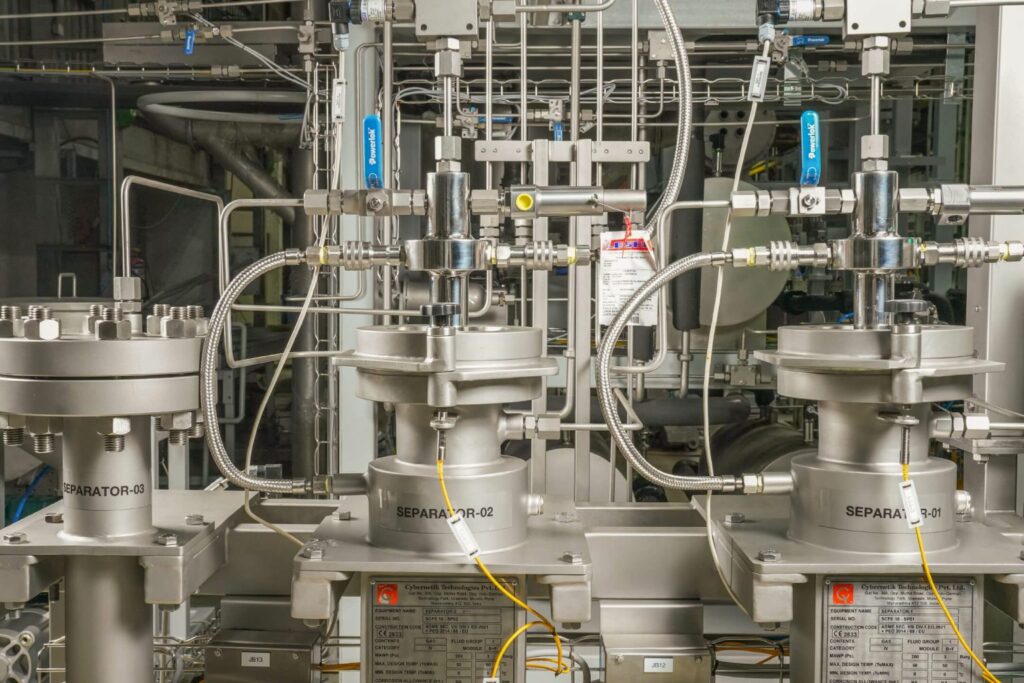
The separator design of industrial CO2 extraction machines is specifically engineered to enable this fractionation. Our article on what makes separator design perfect for complex extracts explains the technical basis for this multi-product output capability.
Certifications That Protect the Investment
A CO2 extraction machine investment in ginger processing is protected by the certification structure of the equipment itself:
- GMP certification: Ensures contaminant-free isolation of active compounds - a baseline requirement for ginger supplements destined for pharmaceutical and nutraceutical markets.
- CE certification: Confirms compliance with EU safety standards - required for legal operation and product sale in European markets.
- ASME certification: Validates pressure vessel integrity under American safety standards - required for US pharmaceutical and food-grade production.
- ATEX certification: Enables safe operation with co-solvents - allows expansion of extraction capability to polar compounds not soluble in pure CO2, adding further product portfolio flexibility.
Our detailed guide on how Buffalo Extraction Systems ensures GMP compliance explains how equipment certification directly protects market access and product liability.
The Compound Advantage: CO2 Cost Economics at Scale
One factor that systematically underestimates the ROI of CO2 extraction machines is CO2 recirculation efficiency. Modern industrial CO2 extraction systems achieve CO2 recovery rates exceeding 95% through closed-loop recirculation. This means the ongoing solvent cost per kilogram of ginger processed is minimal - typically representing less than 5% of total operational cost versus 20–35% for solvent costs in hexane-based systems. Our analysis of how high-capacity CO2 recirculation systems reduce operational costs quantifies this advantage in operational terms.
Conclusion
A supercritical CO2 extraction machine is the single most flexible, highest-ROI capital investment available to a ginger processing business in 2025. It handles every commercially relevant type of ginger, produces every commercially valuable ginger product stream, meets every certification requirement for premium market access, and generates product value at price points - particularly for organic ginger and pharmaceutical-grade supplements - that conventional extraction equipment cannot reach. For businesses committed to ginger processing at any scale, CO2 extraction is not a premium option - it is the defining infrastructure investment.
FAQs
Q: What are the main types of ginger used in commercial extraction?
A: The main types include: fresh green ginger (high moisture, delicate aroma), dried ginger (higher shogaols, preferred for supplements), baby ginger (mild profile), mature rhizome (highest gingerol yield for pharma-grade), organic certified ginger (for organic extract markets), and related Zingiberaceae species including black ginger (Kaempferia parviflora) and galangal. Each type produces a distinct CO2 extract profile.
Q: Can one CO2 extraction machine process different types of ginger?
A: Yes. A supercritical CO2 extraction machine processes different types of ginger by adjusting extraction recipe parameters - pressure (100–350 bar), temperature (35–65°C), CO2 flow rate, and extraction time - without hardware modification. This makes CO2 machines the most versatile ginger extraction investment available.
Q: What ginger products can be produced from a single CO2 extraction machine?
A: A single CO2 extraction machine with multi-stage separators can produce: (1) ginger CO2 essential oil (volatile fraction, 15–30% essential oil content), (2) ginger CO2 oleoresin (full-spectrum with gingerols 5–25% and shogaols 0.5–5%), (3) full-spectrum combined extract, and (4) organic variants of all the above when certified organic raw material is used.
Q: What is the estimated payback period for a CO2 extraction machine in ginger processing?
A: Payback periods vary by scale and capacity utilization: Level 1 systems (USD 80K–250K CAPEX) - 12–24 months; Level 2 systems (USD 250K–800K) - 18–36 months; Level 3 industrial systems (USD 800K–3M+) - 24–48 months. These estimates assume organic ginger CO2 oleoresin pricing of USD 150–280/kg and moderate capacity utilization.
Q: Why is organic ginger the most profitable input for CO2 extraction machines?
A: Organic ginger CO2 extract commands 4–7x the price of conventional solvent-extracted oleoresin (USD 150–280/kg vs USD 15–40/kg). CO2 is the only processing method compatible with organic certification in all major markets (EU, USA, Japan, India). This combination - organic raw material + CO2 extraction - maximizes per-kg output value while enabling the widest possible global market access.