The spice industry has historically been defined by commodity trading - bulk rhizomes, dried herbs, and crushed seeds moving through multi-tiered supply chains before reaching food manufacturers or flavor houses. The rise of supercritical CO2 extraction machines is fundamentally disrupting this model, creating a new category of high-value, standardized spice-derived ingredients that command premium pricing and meet the most demanding technical specifications in food, pharmaceutical, and personal care applications.
The Spice Industry's Quality Problem
Traditional spice processing faces endemic quality consistency challenges. Moisture content, microbial load, pesticide residues, and bioactive concentration vary significantly between growing seasons, geographic origins, and storage conditions. For food manufacturers sourcing ginger for consistent flavor delivery, this variability represents a real formulation challenge - one that whole spice and even conventional oleoresin fail to fully solve.
Supercritical CO2 extraction machines address this problem at the processing level by providing precise, reproducible control over extraction conditions. Pressure, temperature, CO2 flow rate, and extraction time can be systematically adjusted to target specific compound fractions - allowing operators to consistently produce fresh ginger extract with a defined α-zingiberene content regardless of raw material origin variability.
How CO2 Extraction Machines Operate in Spice Processing
Supercritical CO2 extraction machines operate by pressurizing CO2 beyond its critical point (31.1°C, 73.8 bar), where it acquires the solubilizing power of a liquid with the diffusivity of a gas. For ginger processing specifically:
- Stage 1 - Volatile Fraction (100–150 bar): Preferentially extracts the light volatile fraction - essential oil content of 15–30% comprising α-zingiberene, β-sesquiphellandrene, α-curcumene, β-phellandrene, and geranial. The resulting product is a straw-to-reddish-brown liquid with a warm, spicy, authentic fresh ginger extract profile.
- Stage 2 - Oleoresin Fraction (200–350 bar): Extracts the heavier non-volatile fraction - the oleoresin - containing total gingerols at 5–25% (6-gingerol, 8-gingerol, and 10-gingerol), shogaols at 0.5–5%, zingerone, fatty acids, waxes, and resins.
The ability to fractionate these two distinct product streams from a single raw material input batch is one of the most commercially significant capabilities of advanced CO2 extraction machines. Our article on what makes separator design perfect for complex extracts explains the engineering behind this fractionation capability.
Spice Industry CO2 Extraction Adoption: A Category-by-Category View
Ginger is one example in a broader spice industry transformation. The table below compares CO2 extraction adoption across eight commercially significant spice categories, highlighting the standardized compounds, dominant end-markets, and price premium each CO2 extract commands over conventional extraction. Data reflects industry-reported benchmarks compiled.
Spice / Botanical | Primary CO2 Extract Form | Key Standardized Compound | Dominant End-Market | Est. Price Premium vs. Conv. |
Ginger | Essential oil + Oleoresin | Total Gingerols 5–25% | Nutraceuticals, Food | 30–50% |
Black Pepper | Oleoresin | Piperine 40–55% | Nutraceuticals, Pharma | 25–40% |
Turmeric | Oleoresin / CO2 Extract | Curcuminoids 50–95% | Pharma, Supplements | 35–60% |
Cardamom | Essential Oil | 1,8-Cineole, Linalool | Food & Beverage, Fragrance | 20–35% |
Capsicum | Oleoresin | Capsaicin 2–8% | Pharma, Food | 20–40% |
Clove | Essential Oil | Eugenol 70–90% | Dental, Food, Fragrance | 20–30% |
Rosemary | CO2 Extract | Carnosic Acid 5–10% | Food Preservation, Cosmetics | 30–50% |
Vanilla | CO2 Extract | Vanillin + flavor matrix | Premium Food & Beverage | 50–100% |
Key insight: Every spice listed commands a 20–100% price premium when extracted via supercritical CO2 versus conventional oleoresin - with vanilla and turmeric showing the highest premiums due to extreme heat sensitivity and pharmaceutical-grade standardization requirements. Ginger's 30–50% premium reflects its dual-market value in both food flavoring and standardized supplement formulation. The global demand for supercritical fluid extraction equipment is driven precisely by this across-the-board premium gap.
Meeting the Demand for Ginger Extract Supplements
One of the clearest commercial signals of this transformation is the explosive growth of the ginger extract supplements category. According to Nutrition Business Journal, ginger supplement sales in North America exceed USD 100 million annually, with demand for standardized gingerol content growing at double-digit rates.
Producing ginger extract supplements that meet pharmacopoeial standardization requirements - guaranteed 5% or 10% gingerol content - requires extraction machines capable of consistent, controlled extraction and post-extraction fractionation. Steam distillation cannot achieve gingerol standardization because gingerols are non-volatile. Solvent extraction can, but at the cost of solvent residue risk and inferior sensory profile.
CO2 extraction machines solve this problem with a single technology platform, producing both the ginger oil co2 extract fraction and the standardized oleoresin fraction from the same equipment investment. Understanding how manufacturers achieve consistent flavor profiles with advanced extraction technologies provides further operational context.
Industrial Scale and Throughput
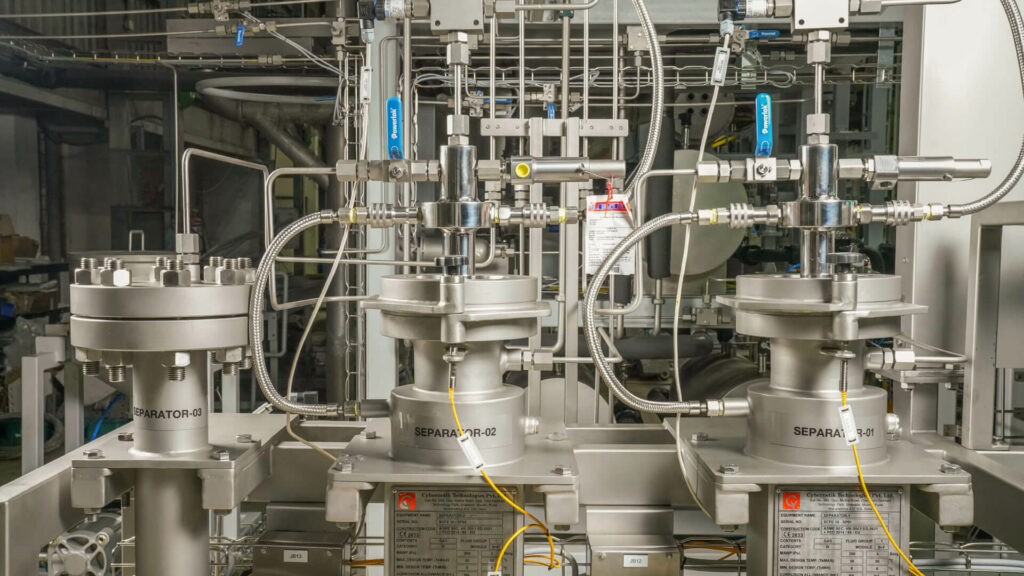
Modern Level 3 industrial CO2 extraction systems can process hundreds of kilograms of dry ginger biomass per day, with automated batch sequencing and integrated CO2 recirculation. Our analysis of faster process benefits of Level 3 supercritical CO2 systems details the throughput capabilities of these industrial-scale systems.
The Spice Industry Landscape in 2030
The trajectory for the spice industry is clear: CO2 extraction machines are becoming the standard production technology for premium spice-derived ingredients. Spice processors who fail to invest in extraction capability risk being disintermediated - supplying commodity raw material to vertically integrated extraction operators who capture the margin at the ingredient level. The window for building extraction capability ahead of full market commoditization is open now.
Conclusion
Supercritical CO2 extraction machines are not an incremental upgrade to the spice industry's processing toolkit - they represent a structural shift from commodity spice trading to precision bioactive ingredient manufacturing. For ginger specifically, the ability to produce standardized ginger oil co2 extract and full-spectrum oleoresin from a single, certified, solvent-free extraction platform positions CO2 extraction as the definitive technology for the premium spice ingredient market.
FAQs
Q: What makes CO2 extraction machines better than conventional spice processing equipment?
A: CO2 extraction machines provide precise control over extraction selectivity, produce solvent-residue-free extracts, preserve heat-sensitive bioactives, and allow fractionation of distinct product streams (volatile oil vs. oleoresin) from a single raw material batch - capabilities unavailable in steam distillation or solvent extraction equipment.
Q: Which spice categories show the highest price premium for CO2 extraction vs. conventional methods?
A: Vanilla (50–100% premium) and turmeric (35–60% premium) show the highest CO2 extraction price premiums due to extreme heat sensitivity of key compounds and pharmaceutical standardization requirements. Ginger commands a 30–50% premium, reflecting dual-market value in food flavoring and standardized nutraceutical formulation.
Q: Can a CO2 extraction machine produce both ginger essential oil and ginger oleoresin?
A: Yes. By operating in sequential pressure stages, a CO2 extraction machine can first collect the light volatile essential oil fraction at lower pressures (100–150 bar), then extract the heavier gingerol-rich oleoresin at higher pressures (200–350 bar) - producing two distinct, commercially valuable products from a single extraction run.
Q: How are ginger extract supplements standardized using CO2 extraction?
A: Standardized ginger extract supplements are produced by controlling extraction pressure to preferentially solubilize gingerols from the oleoresin fraction. The extract is analyzed by HPLC to confirm gingerol concentration, with food-grade and pharmaceutical-grade standards requiring 5–25% total gingerols.
Q: What volume of ginger can industrial CO2 extraction machines process daily?
A: Modern industrial-scale supercritical CO2 extraction systems with Level 3 configurations can process hundreds of kilograms of dry ginger biomass per day, enabled by automated batch sequencing, series-parallel extractor operation, and integrated CO2 recirculation systems.