The Scaling Inflection Point Most Producers Miss
Every successful producer faces the same question: when is the right time to upgrade the essential oil manufacturing process from steam to supercritical CO2? Move too early, and capital sits underutilized; move too late, and competitors capture the premium segments. This article maps the inflection signals and steps that protect the upgrade from common execution failures.
Six Signals That Your Process Is Ready to Scale
- Monthly demand consistently exceeds 200–300 kg of finished oil
- Premium customers (clinical, cosmetic, export) request CO2-extracted SKUs
- Retail or distribution buyers require residue-free third-party testing
- Steam output struggles to meet specs for therapeutic-grade buyers
- Regulatory audits flag steam-process limitations
- Margin compression on commodity-grade products is squeezing profitability
- Producers seeing three or more of these are typically past the inflection point.
Why Steam Distillation Limits the Manufacturing Process at Scale
Steam served the industry for centuries and still serves it for commodity-grade volume. At scale, structural limits emerge: thermal degradation losing 30-40% of heat-sensitive bioactives, narrow profile (volatiles only), 12-24 month shelf life limiting export reach, rising steam-generation energy cost, and quality variability across high-volume operations. The unit economics steadily deteriorate against CO2 above 200 kg/month of finished oil.
How the CO2 Essential Oil Extraction Process Compares
The CO2 essential oil extraction process operates at 35–60°C with tunable pressure (100–500 bar), captures both volatile and lipophilic fractions in one cycle, and leaves zero solvent residues. CO2 carries GRAS status under 21 CFR 184.1240 and is not classified as a residual solvent under ICH Q3C. Buffalo's article on scaling from lab to industry - choosing the right extraction equipment size maps the scaling economics in detail.
- 20–40% higher bioactive yield per kg of raw material
- 24–36 month shelf life on finished oil (vs 12-24 for steam)
- Premium pricing 30–50% above steam-distilled output
- Multi-botanical operation on one platform via SCADA-locked recipe changeover
- Lower per-kg operating cost above 100 kg/month finished oil
CO2 Essential Oil Extraction Equipment - The Modular Path
Modular CO2 platforms protect scaling investments by letting producers add capacity in stages. A typical scaling sequence:
Stage 1 - Pilot validation: 5–10L extractor, 3–6 months recipe development
Stage 2 - Commercial entry: 25–50L extractor or pilot scaled up, 12 months ramping production
Stage 3 - Mid-commercial: 100L extractor or multiple smaller vessels, 24–36 months retail-channel build
Stage 4 - Industrial: 200L+ extractor or multi-vessel installation, contract manufacturing or established-brand scale
CO2 essential oil extraction equipment supplied in modular form can take producers through all four stages without disposing of and replacing the core platform.
Migration Risks and How to Mitigate Them
- Customer-spec transition: maintain parallel steam and CO2 production for 6–9 months to validate matched profiles
- Capital deployment: stage capex through pilot validation before industrial capacity
- Operator training: 3–6 months of training before full commercial production
- Regulatory: complete IQ/OQ/PQ validation per GMP requirements (21 CFR Part 211) before serving regulated channels
- Cash flow: model 12–18 months of dual operating costs
Market Context for the Scaling Decision
The global essential oils market is expanding from USD 15.01 billion in 2026 to USD 34.80 billion by 2034 at 11.08% CAGR, with the premium and therapeutic-grade segments growing fastest. The global demand for supercritical fluid extraction equipment - market growth and opportunities article details the equipment market context. The supercritical CO2 extraction equipment market itself is projected to reach USD 3.0 billion by 2032 - capital is flowing into CO2 capacity for clear strategic reasons.
ROI Timeline for the Upgrade
Illustrative ROI for a producer upgrading from a 50L steam operation to a 50L CO2 system processing premium-grade lavender, rose, or frankincense:
Cost / Benefit Line Item | Annual Impact (USD) |
|---|---|
Total upgrade investment (capex) | 1.2-1.5 million |
Revenue lift from premium pricing | +300K-600K |
Operating cost savings (energy, labor, waste) | +50K-150K |
Reduced batch-rejection cost | +30K-80K |
Insurance + ATEX overhead savings | +10K-25K |
Typical payback period | 36-60 months |

Comparing CO2 Against Other Extraction Methods of Natural Essential Oils
For producers scaling beyond commodity-grade volume, CO2 has become the structural answer because no other method (steam, solvent, cold pressing, hydrodistillation) clears purity, yield, and shelf-life requirements simultaneously at scale.
Industrial-Output Acceleration Engineering
At an industrial scale, additional optimizations protect throughput. Buffalo's piece on accelerating industrial output - faster process benefits of level-3 supercritical CO2 systems details the engineering levers - multi-vessel parallel operation, automated changeover, predictive maintenance reducing unplanned downtime 60-80%, and SCADA-driven recipe libraries for batch-to-batch consistency.
Practical Implementation Roadmap
Months 1–3: Commercial analysis, capacity sizing, vendor evaluation
Months 4–6: Pilot CO2 validation, recipe development for top SKUs
Months 7–12: Equipment procurement, facility prep, IQ/OQ/PQ
Months 13–18: Parallel steam and CO2 production, customer transition
Months 19–24: Full CO2, steam phase-out, certification stack completion
How Buffalo Extraction Systems Supports the Scaling Decision
Buffalo Extraction Systems engineers CO2 platforms for producers scaling from steam to supercritical. Pilot-to-industrial modular construction, IQ/OQ/PQ documentation, SCADA recipe libraries, ATEX-rated safety zones, and hygienic-design construction come standard.
Conclusion
Scaling from steam to supercritical CO2 is one of the largest strategic decisions a producer makes. Signals are clear: demand crossing 200–300 kg/month, customer demand for CO2-extracted SKUs, regulatory tightening around residue-free standards. Producers executing structurally - pilot validation, modular scaling, parallel transition - protect both capital and competitive position.
Frequently Asked Questions
Q1. When does it make business sense to scale the essential oil manufacturing process from steam distillation to CO2?
Most producers reach the scaling inflection point when monthly demand exceeds 200–300 kg of finished oil, when premium customers begin requesting CO2-extracted SKUs, or when export-channel buyers require residue-free documentation that steam-distilled output cannot reliably provide. At that point, the economics, the market signal, and the regulatory trajectory all align in favor of upgrading.
Q2. How does the essential oil extraction process change when switching from steam to CO2?
The essential oil extraction process under CO2 operates at 35–60°C versus 95–100°C for steam - protecting heat-sensitive compounds. Cycle times are typically 1–4 hours per batch versus 2–6 hours for steam. CO2 captures both volatile and oleoresin fractions in one pass; steam captures only volatiles. Operationally, CO2 is more automated, less labor-intensive, and far more documentation-rich.
Q3. What CO2 essential oil extraction equipment is needed for the upgrade?
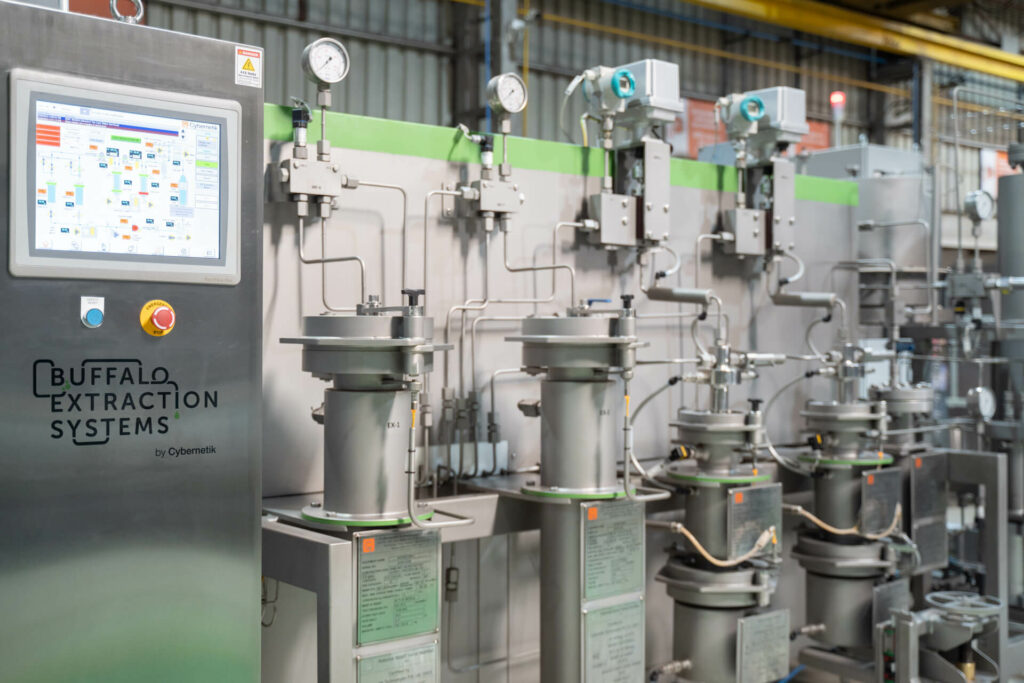
The core CO2 essential oil extraction equipment package includes a high-pressure extractor vessel, CO2 pumps and pressurization system, separator vessels for compound fractionation, CO2 recirculation and recovery loop, SCADA control system, and ATEX-rated safety infrastructure. Modular systems allow producers to start at pilot scale and add capacity as demand develops.
Q4. How is the extraction of essential oils improved by switching to CO2?Extraction of essential oils via CO2 typically yields 20–40% more bioactive compounds per kg of raw material than steam distillation, produces oil with 24–36 month shelf life versus 12–24 months for steam, and supports premium pricing 30–50% above steam-distilled equivalents. The combination of higher yield, longer shelf life, and stronger pricing is what makes scaling investment pay back within 3–5 years.
Scale from steam distillation to CO2 manufacturing. Buffalo Extraction Systems supplies CO2 platforms used by producers worldwide to scale their essential oil manufacturing process - modular, GMP-ready, audit-ready. → Discuss your scaling roadmap: buffaloextracts.com |